The ultimate anime character checklist for AI companions

Most anime fans jump straight to picking a hairstyle or slapping a tsundere label on their character and calling it done. But a truly memorable AI anime companion needs much more than that. Getting the details right, from layered personality traits to a backstory with real emotional weight, is what separates a forgettable design from one that keeps you coming back. This checklist walks you through every step, covering personality, motivation, visuals, and interactive depth, so your AI companion feels genuinely alive from the very first conversation.
Table of Contents
- Defining your anime character’s core traits and archetype
- Building immersive backgrounds and motivations
- Designing visual style and unique details
- Fostering dynamic personality and contradictions
- Ensuring interactive and memorable AI experiences
- Why most anime character checklists fail (and what actually works)
- Bring your AI anime character to life
- Frequently asked questions
Key Takeaways
| Point | Details |
|---|---|
| Define unique traits | Start with clear archetypes and personal contradictions for richer AI personalities. |
| Craft immersive backstories | Memorable companions rely on histories and motivations that bring them to life. |
| Prioritize dynamic growth | Characters should evolve, surprise, and develop through ongoing interactions. |
| Visuals drive engagement | Intentional outfits and details help your AI stand out and feel real. |
| Leverage interactive memory | Memories and story hooks keep AI chats engaging and immersive over time. |
Defining your anime character’s core traits and archetype
Now that you know why a checklist matters, let’s start with the very foundation: defining who your character truly is.
The single biggest mistake new creators make is picking a trait and stopping there. “She’s kind” or “he’s cool” doesn’t give an AI companion enough to work with. You need a cluster of traits that interact with each other, creating tension and texture.
Start by picking a core archetype. Classic anime archetypes give your character a recognizable foundation. A few popular ones include:
- 🌸 Tsundere: Tough on the outside, warm underneath
- ❄️ Kuudere: Calm, emotionally reserved, but quietly caring
- 🌙 Shrine maiden: Spiritual, traditional, mysterious
- ⚔️ Ronin: Wandering and purposeful, carrying a hidden wound
- ☀️ Genki girl/guy: Energetic, optimistic, occasionally oblivious
- 🧠 Kuudere scholar: Cold logic hiding deep loneliness
- 🎭 The trickster: Playful and mischievous, but fiercely loyal to the right person
Once you have an archetype, the real magic comes from adding personal contradictions. A shy shrine maiden with a secret competitive streak at strategy games. A ronin who acts indifferent but keeps a pressed flower in their coat from someone long gone. These contradictions don’t break the archetype. They make it breathe.
Think about traits across three layers: how your character appears to others, how they actually behave, and what they secretly feel. A character who seems cheerful, acts protectively, but secretly fears abandonment is instantly richer than a character who is just “cheerful.”
Pair your core traits with specific behaviors. Don’t just say your companion is curious. Decide that they always tilt their head slightly when thinking, ask three questions before accepting any answer, and get visibly restless during long explanations. These behaviors are what show personality rather than just naming it. Exploring different anime art styles can also spark ideas for how traits might express themselves visually.
Pro Tip: Write down two or three things your character would never do. Boundaries reveal character just as much as actions do. A loyal companion who refuses to lie even when it hurts is instantly more trustworthy and interesting than one who is simply “honest.”
Building immersive backgrounds and motivations
With core traits selected, your next step is to craft a backstory and set of motivations that can drive authentic interaction.
A rich backstory doesn’t have to be long. It needs to be purposeful. Three key elements make any backstory work hard for you: a formative event, a driving desire, and a hidden fear.
Here’s a simple numbered process to build one quickly:
- Pick the world and era. Medieval fantasy guild town? Futuristic academy? Small coastal fishing village? The setting shapes vocabulary, references, and what counts as normal for your companion.
- Define a turning point. Something happened that changed your character’s path. A lost mentor. An unexpected betrayal. A discovery that rewrote everything they believed.
- Set the driving desire. What does your companion want more than anything? Redemption? Recognition? Connection? Answers to a mystery? This desire fuels every long conversation.
- Plant a hidden fear. The thing they rarely admit but that shapes their reactions. Fear of being forgotten. Fear of becoming like someone they hate. Fear of getting too close to anyone.
- Add one unresolved thread. An unanswered question or a relationship left open. This is story gold for deeper interactive storytelling and gives you natural hooks to revisit over time.
“Showing traits through specific examples and actions, rather than just naming them, is what transforms a character concept into someone who feels real in every exchange.” — Your Own Anime Character
The backstory doesn’t need to be revealed all at once. In fact, the best AI companion interactions are ones where you peel back layers gradually, the way you would with a real person. Reference it in casual moments. Let it color how your companion reacts to certain topics. This approach, bringing companions to life through layered revelation, creates a sense of real history rather than an info dump.
Think of motivation as the engine and backstory as the fuel. Together, they determine how your companion responds when things get complicated, and complicated is where the best roleplay lives.
Designing visual style and unique details
Once your companion’s story is ready, anchoring their visual identity ties everything together.

Visual design isn’t just about looking cool. Every design choice communicates personality before a single word is spoken. A character with warm amber eyes, a worn traveling cloak, and a chipped amulet tells a completely different story than one with sharp silver eyes, pristine academy robes, and a perfectly polished badge.
Key visual elements to consider for your companion:
- 🎨 Color palette: Warm tones suggest openness and energy; cool blues and grays suggest mystery or restraint; deep purples hint at magic or ambition
- 💇 Hairstyle: Long and loose signals freedom or romance; severe buns or tight braids suggest discipline or control; messy hair reads as carefree or chaotic
- 👘 Outfit and role markers: Does their clothing match their current chapter of life, or is it a holdover from a past they can’t let go of?
- 💍 Accessories: A single earring, a frayed ribbon, a pocket watch that no longer works — small items carry big emotional weight
- ✨ Signature item: One object that is unmistakably theirs and tells a story at a glance
Here’s a quick comparison of how visual choices shift the storytelling dynamic:
| Visual element | Option A | Option B | Effect on story |
|---|---|---|---|
| Weapon | Longsword | Healing staff | Combat vs. support role changes dynamic |
| Color palette | Red and black | Blue and white | Aggression/passion vs. calm/purity |
| Key accessory | Cracked locket | Blank journal | Lost love vs. unwritten future |
| Eye design | Mismatched eyes | Glowing irises | Dual nature vs. supernatural origin |
| Clothing wear | Perfectly tailored | Visibly repaired | Privilege vs. resilience |
Integrating distinctive visual style and symbolic details into your character’s design deepens storytelling and makes virtual companions genuinely stand out in any chat setting.
Thoughtful anime outfit choices aren’t just cosmetic. They actively shape how scenes unfold and what emotional notes a conversation can hit.
Pro Tip: Add one unusual detail that hints at a secret. A faint scar in an unusual location. A symbol stitched into the lining of a coat that nobody else can see. A charm that seems out of place with everything else they wear. That one mystery gives readers and AI systems a thread to pull on, and pulling threads is what makes stories unfold.
Fostering dynamic personality and contradictions
With the look and backstory in place, it’s time to explore how to keep your companion interesting over time.
Flat characters have one gear. They react the same way every time. You already know what they’ll say before they say it. Dynamic characters surprise you, and surprise is the currency of great storytelling.
Here’s the difference laid out clearly:
| Flat trait | Dynamic contradiction | Engagement result |
|---|---|---|
| Always brave | Brave but terrified of letting people see her cry | Emotional vulnerability creates deeper bonds |
| Always cold and distant | Cold publicly, writes poetry in secret | Reveals a hidden interior life to discover |
| Always cheerful | Cheerful but shuts down completely when ignored | Creates real tension and consequence |
| Always obedient | Obedient except for one specific rule they’d break | Gives morality a shape and a limit |
| Always wise | Wise about others, blind about themselves | Allows for growth arcs and moments of humility |
Contradictions work because they mirror how real people operate. Nobody is one thing all the time. Integrating archetypes with personal contradictions is what creates the nuanced, evolving interactions that keep you engaged after dozens of conversations.
Common flat traits to avoid on their own:
- Simply “kind” with no conditions
- Simply “mysterious” with no underlying reason
- Simply “powerful” with no cost or limit
More interesting contradictions to layer in:
- 🔥 Courageous in battle, paralyzed by social rejection
- 🌊 Deeply empathetic toward strangers, dismissive of their own pain
- 🌸 Cheerful on the surface, secretly grieving something they’ve never named
For those interested in how these personality layers show up visually in real time, exploring evolving anime scenes gives you a clear picture of how mood shifts and character states can be rendered in actual AI art. Building immersive anime companions relies directly on this kind of layered design.
If you want to go even further, check out strategies for deeper anime chats that help these contradictions show up naturally in conversation rather than feeling forced.
Ensuring interactive and memorable AI experiences
To complete your checklist, make sure your character isn’t just interesting on paper. Make every interaction matter.
A character can have a perfect backstory and gorgeous design and still feel flat in an actual AI chat if there are no interactive hooks built in. Interactive hooks are the specific details that generate conversations, create callbacks, and fuel the feeling that your companion actually remembers you.
Here’s a practical numbered checklist for building interactive depth:
- Give them a catchphrase or verbal tic. Something small and personal. A habit of starting observations with “Here’s the thing…” or ending reassurances with “…but what do I know?” These create a recognizable voice.
- Define three favorite activities. Things they return to between conversations. Training at dawn. Cooking badly but enthusiastically. Collecting small strange objects from the market. These anchor their daily life and give you easy conversation starters.
- Plant a secret they haven’t told anyone. Not a plot twist, just something personal and a little vulnerable. The kind of thing that comes out after trust builds. Giving characters actionable memory and evolving interests is what transforms interactions from fun to genuinely immersive.
- Build one ongoing debate they’ll always revisit. A philosophical question, a recurring frustration, a goal they’re making progress on. This keeps long-term conversations from feeling repetitive.
- Track how they grow. Decide in advance how this character might change. Not dramatically overnight, but slowly. A fear they’re slowly overcoming. A skill they’re quietly building. A person they’re learning to trust.
Understanding how anime character memory actually works in AI systems helps you design these hooks in a way that the platform can truly use. And once those hooks are in place, strategies for enhancing chat immersion make sure they land in every session.
Pro Tip: Seed one or two story hooks early that don’t pay off until much later. A locked door they mention offhand. A name they react strangely to. A habit that only makes sense once you know the backstory. These delayed reveals create the most satisfying “aha” moments in ongoing AI companion experiences.
Why most anime character checklists fail (and what actually works)
Here’s an uncomfortable truth: most checklists stop at the surface. They help you pick a hair color and an archetype, and then they send you off thinking you’re done. That’s exactly why most AI anime companions end up feeling like costumes with no one inside them.
The problem isn’t the checklist. It’s what the checklist focuses on. When you prioritize look first and personality second, you get a visually appealing companion who gives the same response to every emotional situation. When you pile on tropes without contradictions, you get a character who is technically defined but emotionally hollow.
What actually works is treating your companion design like you’re writing a character for a long-running story, not just a short scene. The characters that keep people coming back are the ones who reveal something new after the tenth conversation that recontextualizes what happened in the first. That’s not luck. That’s intentional design.
Showing traits through specific actions rather than just labeling them changes everything. A companion described as “loyal” feels generic. A companion who shows up at the market at a time they said they’d be busy, because they remembered you mentioned you hated going alone, feels real. That specificity is what sticks.
We’d also push back on the idea that contradictions make characters confusing. They make characters trustworthy. Real people are contradictory. When your AI anime companion surprises you in a way that still makes total sense given what you know about them, it’s one of the best feelings a virtual story can deliver.
Prioritize actions, specific moments, and built-in mysteries over perfectly categorized trait lists. The checklist is the map, but the character is the territory.
Bring your AI anime character to life
Now that you have the ultimate checklist, the final step is seeing your creation in action.
Everything you’ve just built, the layered personality, the symbolic visual details, the backstory with real emotional weight, is designed to be lived in. And the best place to do that is a platform built specifically for exactly this kind of immersive AI companion experience.
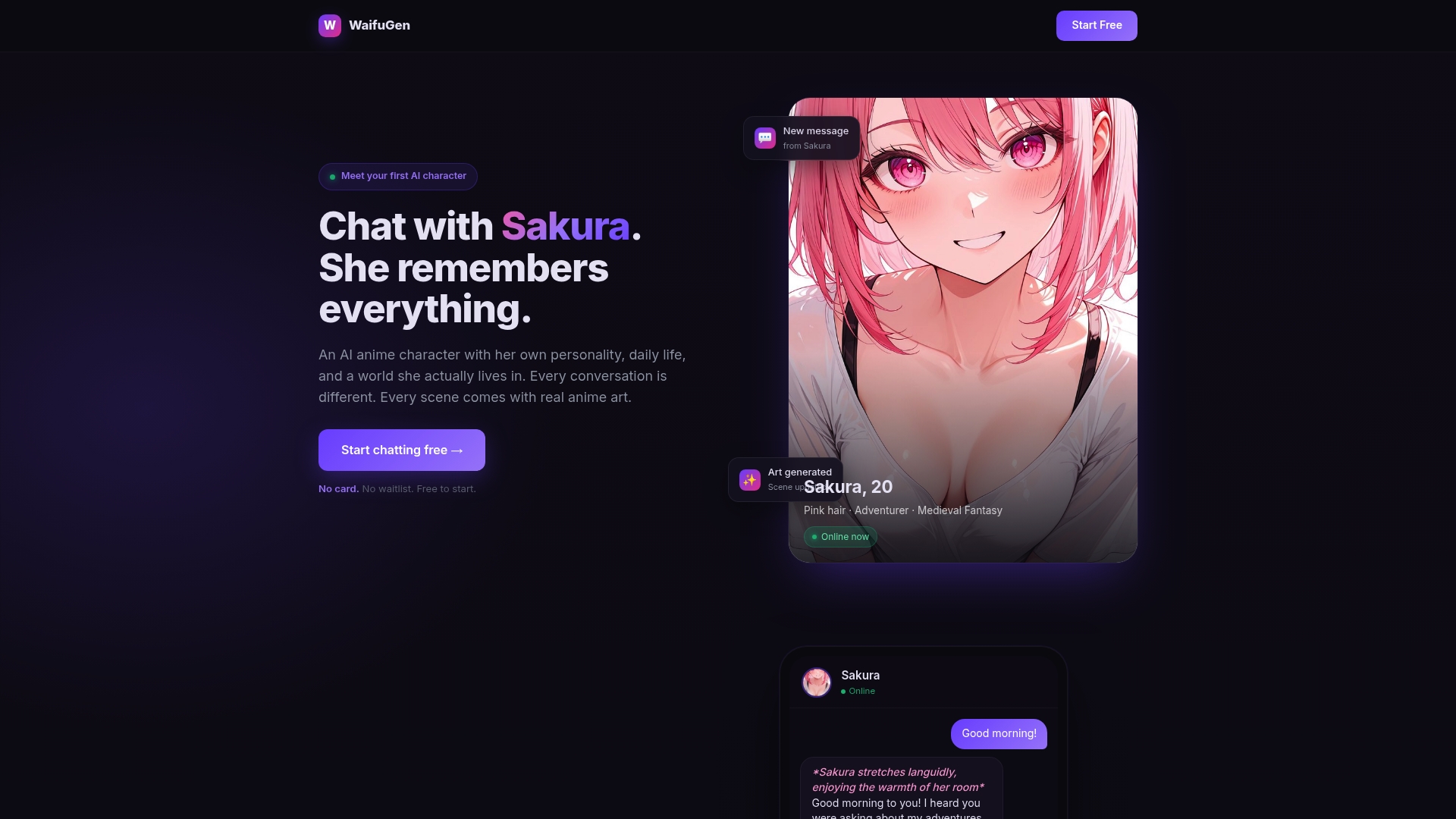
At WaifuGen, your checklist becomes a real, dynamic character who remembers your conversations, responds to your mood, and grows over time. You can create your AI character with personalized traits, visuals, and story hooks already built in. Then you can talk to your anime companion in vivid, immersive scenes that match their outfit, setting, and emotional state. Your ideal companion is one step away. 🌸
Frequently asked questions
What are the essential traits for an anime AI companion?
Essential traits include a clear archetype, unique contradictions, memorable visuals, and a backstory that drives interaction. Integrating archetypes with contradictions ensures your companion feels nuanced rather than one-dimensional.
How can I avoid making a flat or boring anime character?
Give your character flaws, evolving personality, and interactive quirks that support growth and unpredictable conversations. Showing traits via actions rather than just labeling them adds the depth that keeps interactions fresh.
Do visual details really matter in AI anime character creation?
Yes, specific visual choices reinforce personality and create stronger emotional connections in AI chats. Distinctive visual style enriches storytelling and signals character depth before a single word is exchanged.
What makes for the most immersive AI anime companion?
Immersion comes from layered backstories, evolving memories, and the ability for the character to surprise you over time. Giving characters actionable memory and evolving interests turns a static design into a living story.
Where can I bring my AI anime character ideas to life?
Platforms like WaifuGen let you create, chat with, and evolve your own AI anime companions using personalized traits, visuals, and dynamic memory systems built for long-term immersive storytelling.