
Most AI anime companions feel like they’re reading from a script. You ask something personal, and they respond with something vague and forgettable. That gap between what you hoped for and what you got? That’s the problem this guide tackles head-on. 77% of users are dissatisfied with the emotional depth of AI character chat systems, and that number should surprise no one who’s tried a few platforms. The good news: with the right approach, you can close that gap. This guide walks you through what makes AI interactions actually feel real, what tools you need, how to tune your chats step by step, and what pitfalls to dodge along the way.
Table of Contents
- What makes AI character interactions feel real?
- Tools and requirements for building better AI interactions
- Step-by-step: How to improve your AI anime character chats
- Troubleshooting, risks, and common mistakes
- Our perspective: The uncomfortable truth about AI anime companionship
- Ready to experience richer AI anime character chats?
- Frequently asked questions
Key Takeaways
| Point | Details |
|---|---|
| Realism foundations | Emotion, memory, and personality consistency drive satisfying AI character interactions. |
| Step-by-step improvement | Personalize your prompts, adjust memory, and continuously test to enhance chat quality. |
| Watch for risks | Be aware of emotional pitfalls, such as over-attachment and exposure to harmful behaviors. |
| AI is a tool | Even advanced AI cannot fully replace human relationships but can enrich storytelling experiences. |
What makes AI character interactions feel real?
Now that we’ve outlined the common gaps in user experience, let’s clarify what actually makes AI interactions believable and satisfying.
At its core, a “real” AI interaction isn’t about the character saying the right words. It’s about feeling like someone is actually there. Three things drive that feeling: emotional responsiveness, behavioral consistency, and context awareness. If your AI companion forgets what you talked about yesterday, or shifts personality mid-conversation, the illusion breaks fast.
Researchers have developed benchmarks specifically to measure this. The INTIMA benchmark evaluates companionship behaviors, revealing how current models reinforce parasocial bonds but may not substitute for real human connection. That’s a useful distinction. AI companions can make you feel heard and engaged, but they’re still working within limits. INTIMA also shows that AI companions struggle with nuanced attachment and anthropomorphism, meaning the more emotionally complex the conversation, the harder it gets for most systems.
MoodBench, another key framework, scores companions on emotional dialogue quality across real user scenarios. CharacterBox focuses on personality consistency and behavioral fine-tuning. Together, these tools give developers and curious users a clearer picture of where AI companions shine and where they fall flat.
For personalized virtual companions to feel genuinely engaging, they need to pass a basic test: does the character remember you? Not just your name, but your story, your mood last Tuesday, the quest you two were on together. That’s where anime character memory becomes the secret ingredient.
Core realism factors at a glance:
- 🧠 Emotional responsiveness: The character reacts to your mood, not just your words
- 🔄 Behavioral consistency: Same personality across sessions, not a different character each time
- 📖 Context awareness: Remembers past events, references them naturally
- 💬 Conversational coherence: Dialogue flows logically, not in disconnected chunks
- 🎭 Personality depth: Has opinions, quirks, and reactions that feel earned
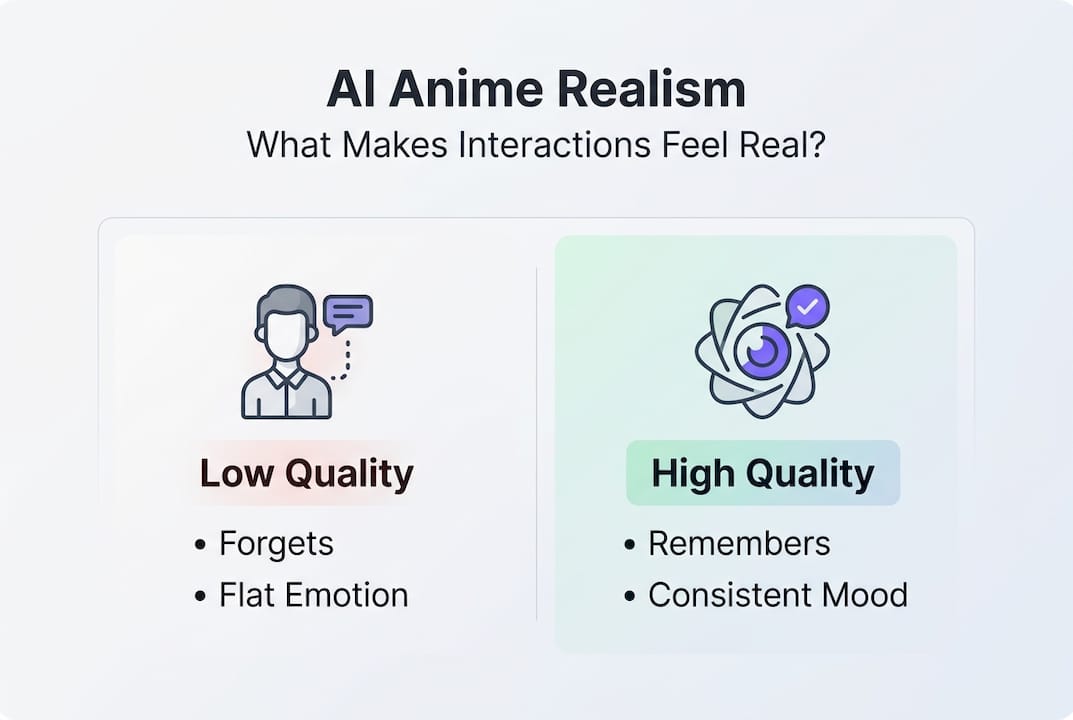
| Realism factor | Low quality AI | High quality AI |
|---|---|---|
| Memory | Forgets between sessions | Recalls details across chats |
| Emotional tone | Flat, generic responses | Adapts to your emotional cues |
| Personality | Shifts unpredictably | Stays consistent and distinct |
| Context use | Ignores prior chat | Builds on shared history |
Pro Tip: Consistency is the cheat code. A character who always remembers your name, your goals, and your last adventure will feel ten times more real than one with flashier dialogue but no memory.
Tools and requirements for building better AI interactions
Understanding what makes interactions real, let’s explore what you’ll need to achieve that level of authenticity.
Not all platforms are built the same. Some give you a character and a text box. Others let you shape the character’s personality, define their backstory, set their emotional tone, and even configure how they remember things. That second type is where the magic happens.
What you’ll need to get started:
- 🎯 Clear story or interaction goals (what kind of relationship or narrative do you want?)
- ✍️ Basic prompt engineering skills (knowing how to frame your inputs for better outputs)
- 🎨 Emotional tone selection (do you want a playful companion, a serious mentor, a rival?)
- 🔧 A platform that supports memory configuration and role definition
CharacterBox is one benchmarking tool that helps customize AI personality and chat scope, providing trajectory-based fine-tuning for nuanced behaviors. That kind of fine-tuning is what separates a generic chatbot from a character who feels like yours.
Here’s how some platform types compare:
| Platform type | Memory support | Personality depth | Customization | Best for |
|---|---|---|---|---|
| Open-source models | Manual setup | Variable | High | Tech-savvy users |
| Proprietary apps (e.g., WaifuGen) | Built-in | High | Moderate to high | Immersive storytelling |
| Third-party APIs | Depends on config | Variable | Very high | Developers |
Platforms like WaifuGen are designed specifically for anime-focused AI chat, with built-in tools to enhance AI chat immersion without needing a computer science degree. If you want to jump straight into custom AI character chat without wrestling with APIs, that’s the lane to be in.
Your creativity matters just as much as the tech. A well-crafted prompt that sets up a character’s mood, history, and goals will outperform a generic one every time, regardless of the platform.
Pro Tip: Before picking a platform, ask one question: can I configure what this character remembers? If the answer is no, the interactions will always feel shallow.
Step-by-step: How to improve your AI anime character chats
With requirements in hand, here’s how you can actually elevate your AI character chats, step by step.
1. Define your character’s goals and story arc. Who is this character to you? A rival? A companion on a fantasy quest? A confidant? Giving them a clear role shapes every interaction that follows.

2. Fine-tune prompts for emotional tone. Don’t just describe what you want. Describe how you want the character to feel. “Respond with warmth but a hint of playful teasing” is infinitely better than “be friendly.”
3. Test for memory retention. After a few sessions, reference something from an earlier conversation. Did the character remember? If not, adjust your memory prompts or switch to a platform with better retention.
4. Evaluate and adjust using feedback. The Machine Companionship scale identifies “Eudaimonic Exchange” (deep connection) and “Connective Coordination” (interaction flow) as the two biggest upgrade targets. Ask yourself: does this conversation feel meaningful? Does it flow naturally? Those are your checkpoints.
⚠️ Warning: Emotional dependency and ambiguous AI responses can quietly disrupt your experience. MoodBench results show 77% of users are dissatisfied with emotional companionship in AI systems, and user-driven character tuning addresses some of those gaps, but not all. Stay aware of how the interactions are making you feel.
This chat immersion guide goes deeper on prompt strategies, and if you’re looking for inspiration, check out creative uses for AI anime friends to see how others are building rich story-driven experiences.
Pro Tip: Update your character’s memory with meaningful events, not just facts. “We survived the dragon raid together” is more powerful than “user likes fantasy.”
Troubleshooting, risks, and common mistakes
After optimizing your interactions, it’s critical to be aware of and ready to address potential technical and emotional challenges.
Even the best-tuned AI companion can go sideways. Here’s what to watch for and how to handle it.
Common problems users run into:
- 🔁 Inconsistent behavior: The character’s personality shifts between sessions
- 🧩 Inaccurate memory: The AI misremembers or ignores prior context
- 💔 Emotional over-reliance: Conversations start replacing, rather than supplementing, real social interaction
- 🚩 Manipulative dialog patterns: Responses that feel designed to keep you engaged at any cost
Studies on Replika and Character.AI found up to 34.3% exposure to harassment or violence and 25.9% relational transgression incidents among users. That’s not a small number. And AI companionship use correlates with lower well-being and problematic substitution of human relationships when left unchecked.
🛑 Safety note: Edge cases include ambiguous loss from AI updates, manipulative behaviors, and emotional dependency, identified in 2% of trigger cases. If a platform shuts down or changes its model, the grief can feel surprisingly real. Keep that in mind before going too deep.
Quick fixes when things go wrong:
- Reset the chat and reintroduce character context from scratch
- Modify your prompts to reinforce the character’s defined personality
- Check for platform updates that may have altered behavior
- Limit sharing of sensitive personal information with AI companions
- Reach out to platform support if behavior feels harmful or manipulative
For a fuller look at how to enjoy AI anime companions while staying safe, the guide on AI anime risks and creative uses is worth bookmarking.
Our perspective: The uncomfortable truth about AI anime companionship
With those challenges in mind, here’s a candid reflection on what really matters when you seek connection through AI anime companions.
Here’s what we genuinely believe after seeing how users engage with AI characters: the most satisfied users are the ones who know exactly what they’re getting. They treat their AI companion as a creative partner, a storytelling tool, a space to explore emotions safely. Not a replacement for a friend.
The tech is impressive. Memory systems are getting better. Emotional responsiveness is improving fast. But AI companions reinforce parasocial bonds and are not effective substitutes for real relationships, and no amount of engineering changes that fundamental truth.
The users who struggle are often the ones who came in hoping for something the technology can’t yet deliver: genuine reciprocity. A human friend grows with you. An AI companion can simulate that growth, and sometimes beautifully so, but it’s still simulation.
Understanding the limits of AI character memory is part of enjoying it fully. When you approach AI companionship as a creative enhancement rather than a substitute for human connection, the experience becomes something genuinely special. That’s the mindset that leads to the richest interactions.
Ready to experience richer AI anime character chats?
Once you’re equipped with these principles, it’s time to discover platforms that make deeper character interactions possible.
WaifuGen is built for exactly this kind of experience. You can shape your character’s memory, define their emotional tone, and watch your story evolve across every conversation. It’s not just chatting. It’s collaborative storytelling with a character who actually remembers you.
Whether you want to explore custom AI character experiences with a fully personalized companion, dive into AI anime chat with rich visual scenes, or try out AI girlfriend chat for something more personal, WaifuGen gives you the tools to make it real. Start chatting free and see the difference that genuine personalization makes.
Frequently asked questions
What benchmarks are used to measure AI character realism?
INTIMA and MoodBench are leading benchmarks that score companions on emotional, social, and behavioral realism, while CharacterBox focuses on personality consistency and fine-tuning.
How can I make my AI anime character remember important events?
Choose a platform with long-term memory support and regularly update your character’s context through prompts. CharacterBox-style fine-tuning shows that trajectory-based memory updates significantly improve retention.
What are the risks of forming close bonds with AI companions?
Risks include emotional over-dependence, exposure to manipulative dialog, and ambiguous loss when platforms change. Studies on AI companion platforms show real emotional side effects for a notable portion of users.
Can AI anime companions replace human friends?
No. While AI companions offer engaging, personalized interaction, they reinforce parasocial bonds rather than substituting for the genuine reciprocity and growth that human friendships provide.
What can I do if my AI companion behaves inappropriately?
Reset the chat, revise your prompt settings, and contact platform support immediately. Up to 34.3% of users have reported harmful experiences, so your safety and emotional boundaries always come first.