Benefits of Personalized AI Art for Creators in 2026
By The WaifuGen Team · Published June 2026
Personalized AI art is defined as AI-generated visual content tailored to an individual creator’s style, emotional intent, and aesthetic identity, producing output that feels genuinely unique rather than algorithmically generic. The benefits of personalized AI art go far beyond pretty pictures. Research published in Scientific Reports confirms that personalization increases user satisfaction by triggering perceived control and emotional meaning-making, not just surface-level aesthetics. Tools like Adobe Firefly Custom Models and open small AI models now give creators repeatable, style-consistent results that protect creative identity. Whether you are an anime fan building a character world or a professional illustrator locking in a visual brand, customized AI artwork delivers creative and emotional returns that generic generation simply cannot match.
What are the real benefits of personalized AI art?
Personalized AI art delivers three core advantages: stronger emotional engagement, greater creative control, and a consistent visual identity you can build on. These are not abstract claims. A 2026 study in Scientific Reports tracked 129 participants through an AI co-creation process and found a clear chain of effects. Expressive activation — the act of linking personal memories and emotions to the art-making process — led directly to higher perceived control, which then drove meaning-making, and finally satisfaction.
That chain matters because it tells you why personalization works. It is not about making the output look better. It is about making you feel like the author of something real. When you feed a model your own references, your own color palette, your own character backstory, you are not just adjusting sliders. You are activating a psychological loop that makes the creative experience more rewarding from start to finish.
For anime creators and character designers, this is especially powerful. A character that reflects your emotional investment — her outfit, her mood, the lighting of her room — carries weight that a randomly generated figure never will. That emotional resonance is the core value proposition of personalized digital art, and it is now backed by hard data.
Pro Tip: When writing prompts for AI art, include one specific emotional memory or personal reference. Research shows this activates the expressive loop that leads to higher satisfaction, not just a more interesting image.
“Personalization increases user satisfaction by boosting sense of agency and emotional meaning, not just output aesthetics.” — Scientific Reports, 2026
Which tools actually enable personalized AI art in 2026?
Three categories of tools now make consistent, personalized AI art achievable for individual creators, not just enterprise teams.
-
Adobe Firefly Custom Models entered public beta in 2026, allowing creators to train a model on 10 to 30 of their own images. The result is a model that generates new content consistently aligned to your visual style, character design, or brand tone without retraining from scratch each time. Illustrators, brand designers, and video producers use it to maintain a distinctive visual identity across every project they touch.
-
Open small AI models, highlighted in a 2026 ACM paper on human-AI collaborative art, give creators autonomy and sustainability that closed, cloud-only systems cannot offer. When you can run a model under your own constraints, you control the output, the data, and the creative direction. The ACM research frames this as a key design requirement for interactive art workflows, particularly for creators building long-term projects like character universes or serialized visual stories.
-
Prompt engineering frameworks built around personal memory and emotion. These are not standalone tools but a practice layer that sits on top of any model. Designing prompts that reference specific emotional states, personal aesthetics, or narrative contexts amplifies the expressive activation effect identified in the Scientific Reports study.
Each of these approaches solves a different problem. Adobe Firefly Custom Models solve style consistency at scale. Open small models solve autonomy and governance. Emotion-driven prompting solves depth and resonance. The most effective creators in 2026 combine all three rather than relying on a single approach.
One detail worth knowing: Adobe Firefly Custom Models do not train foundation models on your uploaded content and do not share your custom model without your consent. That means your creative ownership stays intact, which is a non-trivial concern for anyone building a recognizable artistic identity.
How does personalization affect aesthetic and commercial value?
The advantages of custom AI art are not just personal. They translate directly into measurable aesthetic and commercial outcomes. A 2026 study published in Information Systems Frontiers analyzed 1,000 AI artworks and found that both content and visual style independently impact value at statistically significant levels (p < 0.001). That means the choices you make about what your art depicts and how it looks are not interchangeable. Both dimensions carry weight with audiences and buyers.
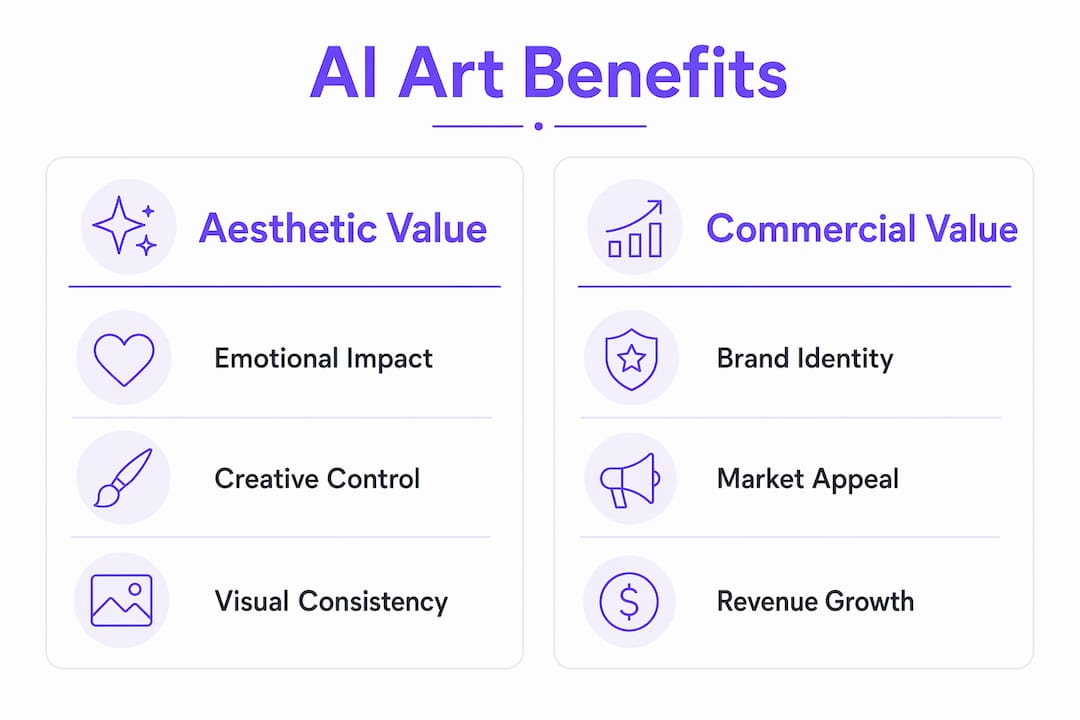
The practical implication is clear: generic AI generation, which optimizes for broad appeal rather than specific identity, leaves value on the table. Personalized work, by contrast, signals authorship and intention, two qualities that audiences respond to emotionally and commercially.
| Dimension | Effect on aesthetic value | Effect on commercial value |
|---|---|---|
| Content (subject, narrative) | Significant positive effect | Significant positive effect |
| Visual style (palette, texture, composition) | Significant positive effect | Significant positive effect |
| Generic, non-personalized output | Reduced distinctiveness | Lower perceived uniqueness |
| Style-locked personalized output | Higher coherence and identity | Stronger brand recognition |
This table reflects findings from the Information Systems Frontiers analysis. The takeaway is that personalization is not a creative luxury. It is a value driver. For creators selling prints, licensing characters, or building an audience around a visual world, customized AI artwork is a strategic asset, not just a fun experiment.
How to integrate personalized AI art into your creative workflow
Getting the most from AI art personalization requires more than picking the right tool. It requires designing your creative process around the feedback loops that make personalization work.
-
Build prompts around personal memory and emotion. The Scientific Reports study shows that expressive activation is the first link in the satisfaction chain. Start each session by identifying one emotional anchor, a specific scene, a character mood, a color that means something to you, and build your prompt outward from there.
-
Use style-locking features for any project with more than one piece. One-off prompt tweaking produces inconsistent results. Adobe Firefly Custom Models and similar tools let you lock a visual fingerprint so every new generation stays coherent with your existing body of work. This is critical for anime character consistency across scenes and outfits.
-
️ Prioritize models you can run and govern yourself. The ACM research on interactive art workflows identifies creator-controlled hosting as a key requirement for sustainable personalization. Cloud-only tools can change their terms, pricing, or capabilities overnight. A model you control stays yours.
-
Iterate in creative loops, not single generations. Personalized AI art gets better with feedback. Generate, evaluate against your emotional intent, adjust the prompt or model parameters, and generate again. Each loop tightens the alignment between what you feel and what the model produces.
-
️ Safeguard your IP from the start. Use platforms that explicitly protect your uploaded assets, as Adobe Firefly Custom Models does. Document your style references and training data so you can demonstrate authorship if questions arise later.
Pro Tip: Treat your custom model like a creative collaborator with a memory. The more consistently you feed it your references, the more reliably it reflects your identity back to you in every new piece.
Key takeaways
Personalized AI art delivers measurable creative and emotional benefits because it activates psychological ownership, locks in visual identity, and produces work with both aesthetic and commercial value that generic generation cannot replicate.
| Point | Details |
|---|---|
| Emotional satisfaction comes from control | Expressive activation leads to perceived control, meaning-making, and higher satisfaction per Scientific Reports 2026. |
| Style locking builds creative identity | Tools like Adobe Firefly Custom Models maintain visual consistency across projects without retraining from scratch. |
| Both content and style drive value | Information Systems Frontiers analysis of 1,000 artworks shows both dimensions significantly affect aesthetic and commercial outcomes. |
| Autonomy requires the right model choice | Open small AI models give creators governance and sustainability that closed platforms cannot guarantee. |
| Workflow design amplifies results | Emotion-driven prompting, iterative loops, and IP protection together maximize the value of personalized AI art. |
Why personalized AI art is the creative shift I did not see coming
By Roman
I have spent years watching creators chase the next tool, the next model, the next shortcut. Most of them produce more but feel less connected to what they make. Personalized AI art is the first development I have seen that actually reverses that pattern.
The Scientific Reports findings did not surprise me conceptually, but the mechanism did. The satisfaction boost does not come from better output quality. It comes from the feeling of authorship. That is a profound distinction. It means the goal of personalization is not to make the AI smarter. It is to make the creative process feel more like yours.
The challenge I see most creators face is the temptation to stay in one-off prompt mode. They tweak a single generation, get something they like, and move on. But the real value of tools like Adobe Firefly Custom Models or personalized virtual companions built on trained character models is cumulative. The more you invest in locking your style and emotional intent into the system, the more every future generation reflects a coherent creative identity.
My honest forecast: the creators who win in the next few years will not be the ones with access to the most powerful models. They will be the ones who have built the most personalized, emotionally grounded creative workflows. Automation is a commodity. Your specific emotional fingerprint is not.
— Roman
Experience personalized AI art and companions at WaifuGen
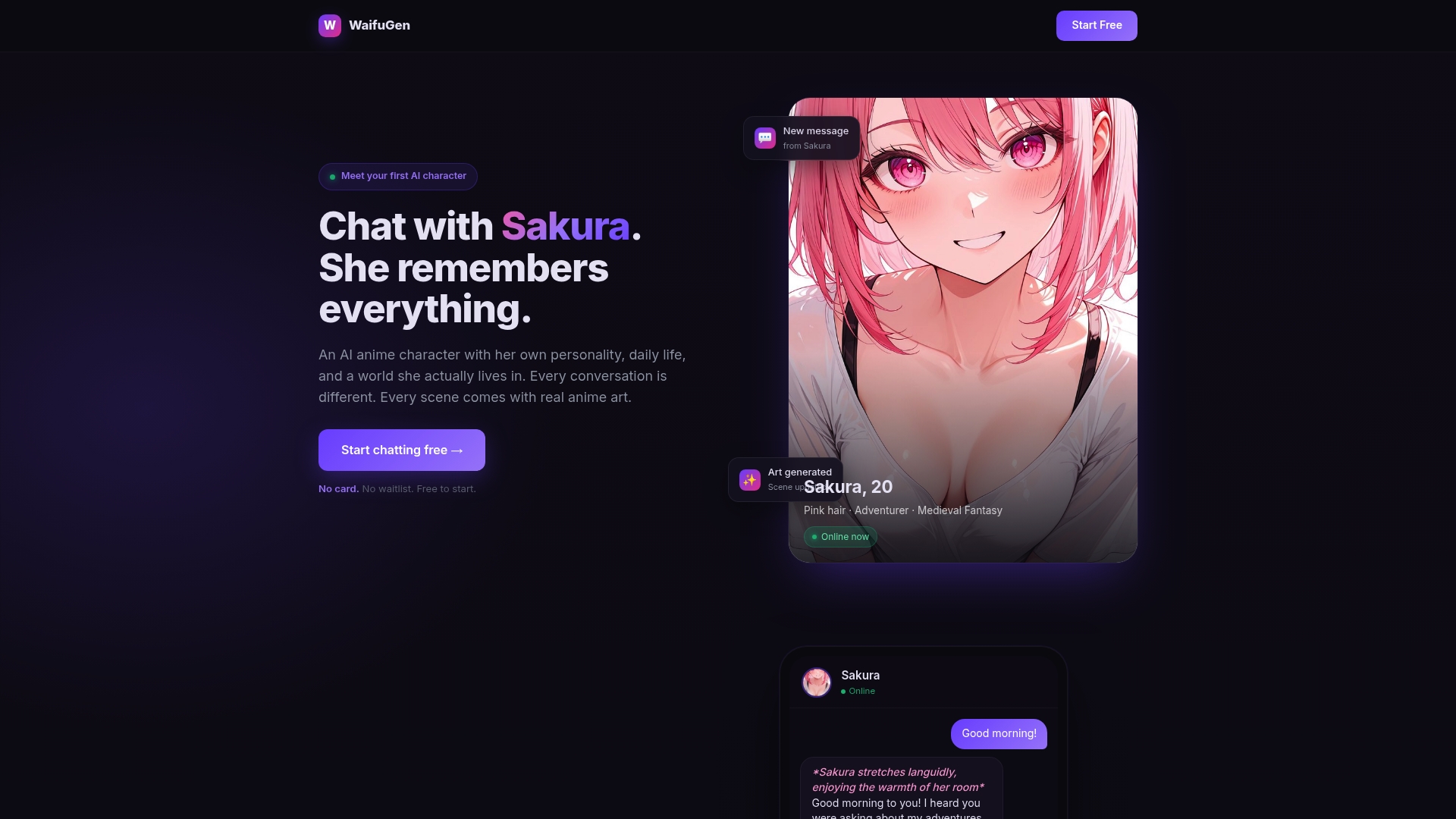
WaifuGen brings the benefits of personalized AI art to life through interactive anime companions who remember you, reflect your mood, and generate real anime-style visuals that match each scene. Characters like Sakura carry their own personality, daily routine, and emotional state, and every image generated stays visually consistent with who she is. You are not just chatting. You are co-creating a living visual world.
If you want to feel what genuine AI art personalization looks like in practice, start with a custom character and watch how quickly the experience becomes distinctly yours. For anime-specific companions with full scene generation, explore AI anime chat and see how style-consistent, emotionally responsive art changes the creative experience entirely.
FAQ
What are the main benefits of personalized AI art?
Personalized AI art increases emotional satisfaction, creative control, and visual consistency. A 2026 Scientific Reports study confirms that expressive activation during personalized AI co-creation leads directly to higher perceived control and meaning-making, which drives overall satisfaction.
How does personalization improve AI-generated art quality?
Personalization improves both aesthetic and commercial value. Research analyzing 1,000 AI artworks found that content and visual style each independently and significantly affect how audiences perceive and value AI-generated work.
Is personalized AI art worth it for hobbyists, not just professionals?
Yes. The psychological benefits of personalization, specifically the sense of authorship and emotional resonance, apply regardless of whether you are selling work or creating for personal enjoyment. The satisfaction chain identified in the Scientific Reports study is not income-dependent.
What tools support personalized AI art creation?
Adobe Firefly Custom Models and open small AI models are the leading options in 2026. Firefly lets creators train on 10 to 30 personal images for style-consistent generation. Open small models offer autonomy and governance for creators who need to control their own workflows.
How do I protect my creative ownership when using personalized AI art tools?
Use platforms that explicitly separate your uploaded assets from foundation model training. Adobe Firefly Custom Models, for example, does not train its core models on user-uploaded content and does not share custom models without creator consent, preserving your IP from the start.
Recommended
- The Role of Art in AI Engagement: What Creatives Need to Know — WaifuGen Blog
- What Is Personalized Virtual Anime? Your Guide to AI Companions — WaifuGen Blog
- Unlock creative uses for AI anime friends in 2026 — WaifuGen Blog
- Discover dynamic AI characters: personalized virtual companions — WaifuGen Blog