Advantages of Anime Scene Generation for Creators

By The WaifuGen Team · Published June 2026
Anime production has always wrestled with one stubborn problem: keeping everything consistent across scenes, episodes, and characters. A room that shifts layout between cuts, a character whose outfit subtly changes, a style that drifts mid-episode. These aren’t just technical annoyances. They break immersion and cost time. The advantages of anime scene generation go far beyond saving a few hours. When you build scenes through a structured AI pipeline, you get spatial accuracy, character coherence, faster production cycles, and the ability to power truly interactive storytelling. Here’s what that actually looks like in practice.
Table of Contents
- Key Takeaways
- 1. The core advantages of anime scene generation
- 2. Spatial consistency across scenes and episodes
- 3. Character consistency across multi-scene storytelling
- 4. Time and cost savings that actually change production math
- 5. Immersive storytelling and interactive entertainment
- 6. Flexibility, style control, and workflow customization
- 7. My take on what creators keep getting wrong
- Experience scene generation in action with WaifuGen
- FAQ
Key Takeaways
| Point | Details |
|---|---|
| Spatial consistency is solved by anchoring | Using a stable first frame as a “canon” reference prevents room layout and geography errors across scenes. |
| Character identity needs pipelines, not just prompts | Appending identity sheets to every scene prompt maintains consistent faces, outfits, and styles across longer outputs. |
| AI cuts production time dramatically | AI-assisted workflows can reduce production cycles from 6–8 weeks to just 1–2 weeks. |
| Style locking protects viewer immersion | Mixing anime styles mid-clip creates subtle but noticeable flicker that damages the viewing experience. |
| Interactive storytelling demands state tracking | Narrative-driven AI scenes require pipelines that track character and scene state across every interaction. |
1. The core advantages of anime scene generation
Anime scene generation, formally known as AI-assisted scene synthesis, uses machine learning models to produce anime-style visual environments from prompts, reference images, or scripted inputs. The term “scene generation” covers everything from static background creation to full multi-shot clip production with character placement.
The key advantage over drawing scenes from scratch is scalability without sacrificing style. You can produce dozens of location variants in the time it once took to finish one. For interactive platforms, that means richer worlds. For independent creators, it means not burning out your team on repetitive asset work.
What makes modern anime scene generation tools particularly powerful is the combination of visual fidelity and workflow integration. You’re not just getting a pretty image. You’re getting a scene that can be tied to a character’s mood, outfit, and current story state.
2. Spatial consistency across scenes and episodes
One of the most underappreciated benefits of creating anime scenes through a structured pipeline is spatial accuracy. Anyone who has run a multi-episode anime project knows the pain: the kitchen counter moves, the window is on the wrong wall, the hallway gets shorter between cuts.
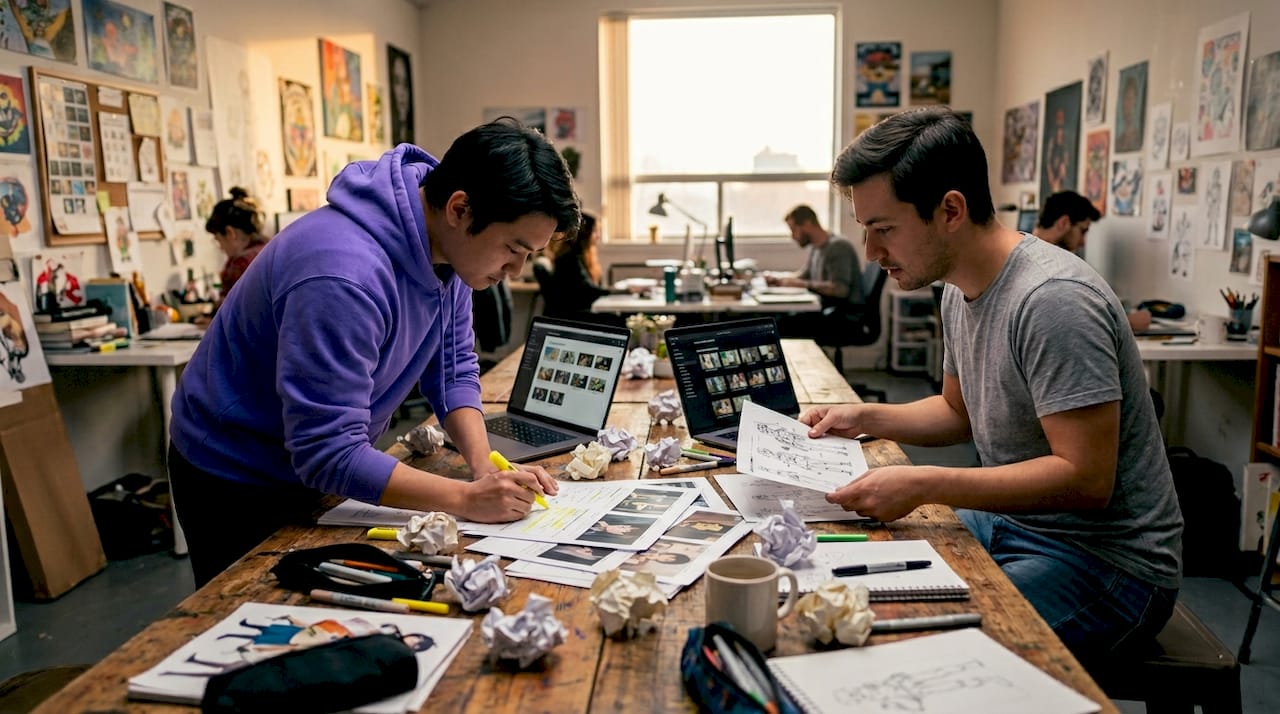
Accurate first frames prevent this entirely. By generating or selecting a single panoramic or pack-shot image as your “canon” reference for a location, you give the model a stable visual anchor to work from. Every subsequent scene in that location is generated against that reference, eliminating the geographic hallucination problem.
Practical techniques that work well here include:
- ️ Panoramic first frames: Generate a wide-angle view of each key location before producing any close shots.
- Pack shot references: Use a scene builder output or photo pack as the master reference image.
- Location libraries: Organize anchors by episode arc so batch generation pulls from the right canon file.
- Batch processing: Generate all scenes within a single location in one session to preserve consistent lighting and geometry.
Separating scene building from motion animation reduces geography hallucination risk even further, since the model isn’t trying to invent spatial relationships mid-clip.
Pro Tip: Batch all scenes set in the same location in a single generation session. Consistent style and geography are much easier to maintain when the model hasn’t “forgotten” your reference between runs.
3. Character consistency across multi-scene storytelling
Keeping a character looking like themselves across 50 scenes is genuinely hard. Hair color drifts. Outfit details disappear. The face shifts slightly in ways that feel off but are difficult to articulate. This is where structured orchestration pipelines make a real difference.
Appending identity sheets to each prompt in a pipeline is the standard approach. An identity sheet captures the character’s face, outfit, hairstyle, and color palette in a reference image that accompanies every scene generation call. The result is a character who actually looks consistent across your entire story.
Key elements of an effective character consistency workflow:
- Identity reference images: One canonical portrait per character, generated at high resolution, used as a persistent reference.
- Style tokens: Short descriptors appended to every prompt that lock in hair color, eye shape, and clothing type.
- Outfit state tracking: For interactive stories, update the identity sheet when the character changes clothes or enters a new narrative arc.
- ️ Orchestration layers: Tools that automate identity sheet attachment across hundreds of prompts save enormous time on longer projects.
This consistency is what enables longer-form outputs. Most standalone AI tools cap reliable coherence at around five minutes of content. Pipelines with identity management push that boundary significantly.
Pro Tip: Create a separate identity sheet for each major costume or scene context, like “Sakura at home” versus “Sakura in the guild hall.” Switching between them keeps your character grounded in each setting without visual confusion.
4. Time and cost savings that actually change production math
The numbers here are significant enough to shift how studios plan projects. AI-assisted animation can cut production cycles from 6–8 weeks down to 1–2 weeks, with cost reductions of 60–70% compared to traditional methods. These aren’t theoretical figures from small test projects. They reflect production-scale workflows where AI handles the repetitive frame work.
Here’s what that looks like in practice:
- In-between frame generation: AI handles 70–90% of in-between frames, the tedious interpolation work that burns out junior animators on traditional productions.
- Background art automation: Scene generation tools produce location variants that previously required dedicated background artists working multiple days per set.
- Iteration speed: Need a different time of day for the same scene? Generate it in minutes, not hours.
- Revision cycles: When a script changes, you regenerate specific scenes rather than redrawing entire sequences.
- Team reallocation: Animators and artists freed from repetitive tasks can focus on character acting, storytelling, and quality control.
Studios using AI-assisted pipelines report that animators spend more time on creative decisions and less on mechanical execution. The output quality actually improves because creative energy goes where it matters most.
The anime production benefits extend to independent creators too. A solo creator or small team can now produce visual content at a scale previously reserved for studios with large budgets.
5. Immersive storytelling and interactive entertainment
This is where anime scene generation moves from a production tool into a storytelling medium. The anime scene design advantages are most visible when you look at interactive formats.
Research on AI-generated storybook illustrations identifies six dimensions of consistency that shape immersive coherence: time, space, character, event and plot, style, and theme. Maintain all six and your story feels alive. Let even two of them slip and the audience notices, even if they can’t name why.
| Consistency Dimension | What Breaks Without It | What You Enable With It |
|---|---|---|
| Time | Scenes feel disconnected or anachronistic | Believable narrative progression |
| Space | Geography shifts between cuts | Grounded, explorable worlds |
| Character | Identity drift across scenes | Emotional investment in characters |
| Event and plot | Story logic collapses | Branching narratives that make sense |
| Style | Visual flicker and tonal mismatch | Aesthetic coherence across the full story |
| Theme | Emotional tone feels inconsistent | Resonant, purposeful storytelling |
AnimeGamer demonstrates what happens when all six dimensions work together. The system uses multimodal AI to generate infinite, continuously evolving anime life simulations by predicting next game states that incorporate both character states and animation states. It’s not a static story. It’s a living one.
“For interactive anime experiences, pipelines must maintain character and scene state across scenes to enable open-ended, evolving storylines, not just static image collections.”
This is why use anime scene generation becomes such a different question when you frame it around interactive entertainment. The floor is compelling visuals. The ceiling is a narrative engine.
6. Flexibility, style control, and workflow customization
One of the quieter advantages of digital anime art pipelines is creative flexibility. You’re not locked into one provider, one style, or one toolchain.
Style locking within a clip is critical here. Mixing different anime styles mid-shot creates subtle but noticeable character inconsistencies that reduce immersion. But style locking doesn’t mean you’re stuck with one look forever. It means you commit to one style per scene or episode arc, then switch deliberately when the narrative calls for it.
Local-first orchestration tools like BlueFish enable iterative scene variants and provider switching without rebuilding entire pipelines from scratch. That means:
- Provider flexibility: Swap image generation models when a better option emerges without losing your reference library.
- ♻️ Asset reuse: Store and recall scene references, character sheets, and location anchors across projects.
- ️ Style variants: Generate the same scene in three different visual styles during pre-production to find the right fit.
- Script-to-video workflows: Connect narrative scripts directly to scene generation calls for faster production runs.
Pro Tip: Decide your style diversity strategy before you start generating. High variety feels fresh but creates continuity risk. Tighter style ranges feel more professional and are easier to maintain across 20 or more scenes.
7. My take on what creators keep getting wrong
By Roman
I’ve watched a lot of creators approach anime scene generation as a collection of individual asset requests. Ask for a background here, a character pose there, stitch them together and call it done. The results look fine in isolation and fall apart the moment you watch them in sequence.
What I’ve learned is that the spatial truth of a scene, whether the room feels like it actually exists and occupies consistent space, is one of the biggest drivers of perceived quality. Viewers don’t consciously notice when a hallway changes length. But they feel something is off. That feeling erodes trust in the story.
The orchestrated pipeline approach isn’t just more efficient. It’s more honest to how good storytelling works. Stories live in worlds that have consistent rules. Scene generation that respects those rules, through anchored references and state-aware pipelines, produces work that feels real even when the characters have cat ears and magic swords.
My honest advice for anyone serious about this: start with your locations, not your characters. Build the world first. Let the characters inhabit a place that already feels grounded. The visual storytelling quality jumps immediately when you work in that order.
— Roman
Experience scene generation in action with WaifuGen
Everything covered in this article points toward one practical reality: scene generation only reaches its full potential when it’s connected to a character with a real sense of self.
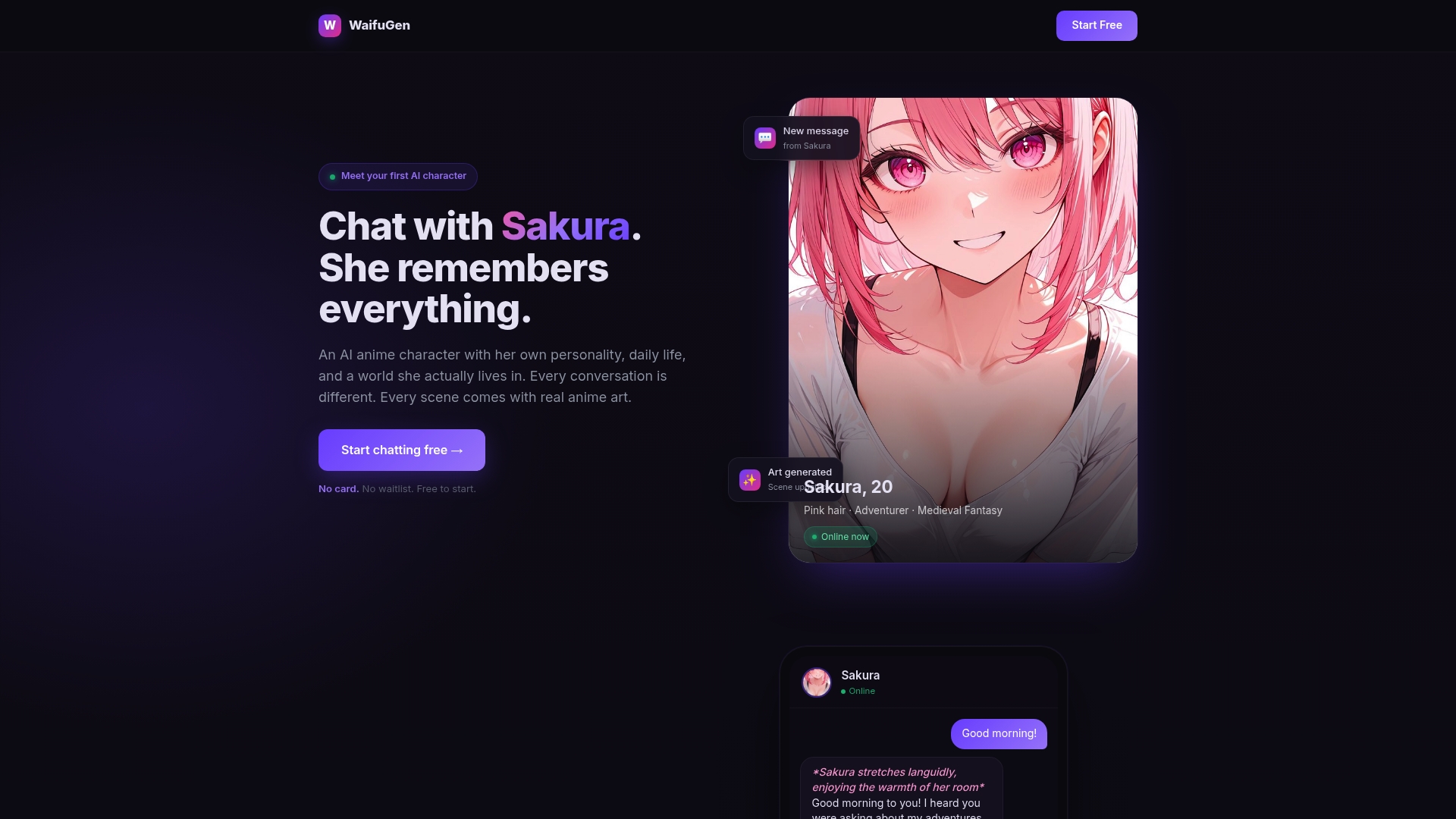
Waifugen builds exactly that. Every character on the platform comes with evolving scenes that match their outfit, setting, and emotional state in real time. Sakura isn’t just a static image. She has a daily routine, a mood, and a world she actually inhabits. The AI character chat experience brings every one of those scene generation advantages into something you can actually interact with. And if you want to see how the whole system fits together, the how it works page breaks down the pipeline behind the scenes. Start chatting free and feel the difference a consistent, living scene makes.
FAQ
What are the main advantages of anime scene generation?
The core advantages include spatial consistency across scenes, faster production cycles, and the ability to support interactive storytelling. AI pipelines handle repetitive frame work while preserving character and style coherence.
How does anime scene generation maintain character consistency?
Appending identity sheets to each prompt in an orchestration pipeline maintains consistent faces and outfits across multiple scenes, preventing the style drift common in single-prompt workflows.
How much time can AI-assisted scene generation save?
Production cycles can shrink from 6–8 weeks to 1–2 weeks with AI assistance, with cost reductions reaching 60–70% compared to traditional animation methods.
Why does style locking matter in anime scene generation?
Mixing styles mid-clip causes subtle character flicker and visual inconsistencies that reduce viewer immersion, even when individual frames look fine in isolation.
Can anime scene generation support interactive and branching stories?
Yes. Systems like AnimeGamer use state prediction models to generate continuously evolving scenes that respond to character and story state, enabling open-ended interactive narratives.