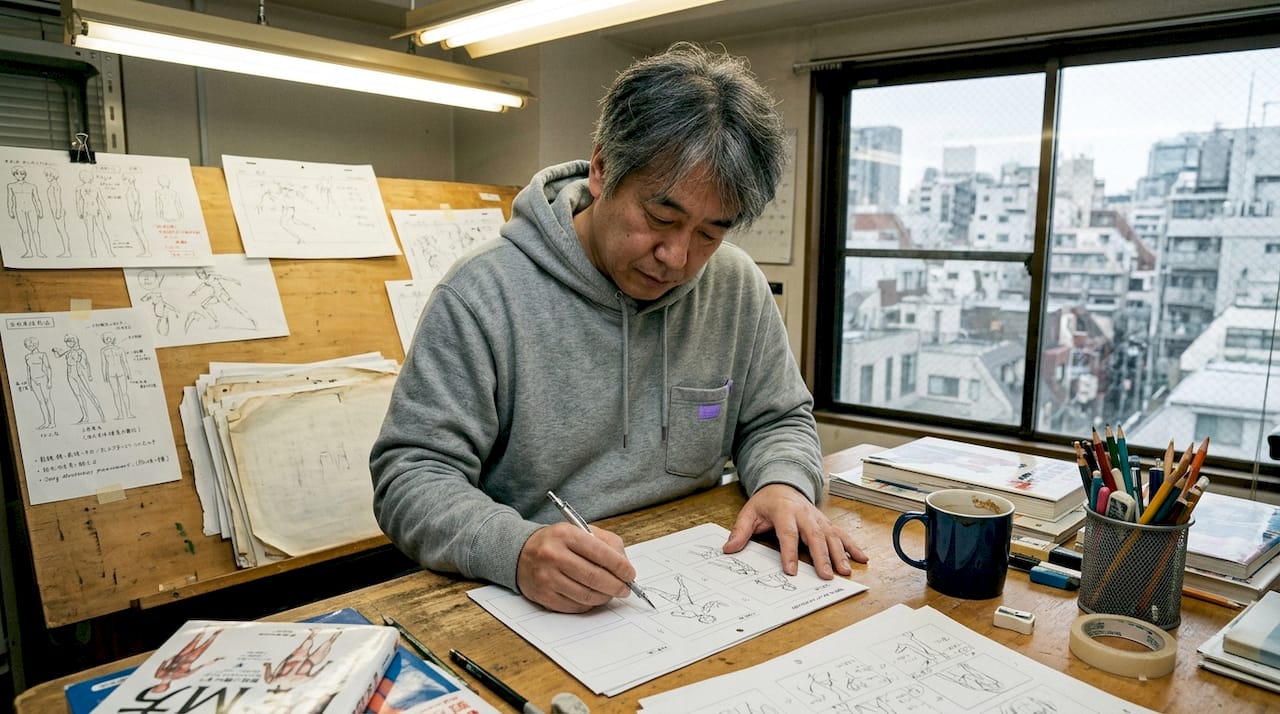
You’ve felt it before. A scene hits, and suddenly you’re sitting forward, heart pounding, maybe even holding your breath. The animation feels alive in a way that the last fifteen minutes didn’t. Most anime fans recognize that feeling instantly, but very few can explain what caused it. The truth is, those moments aren’t accidents. They’re the result of deliberate artistic choices, technical craft, and a deep understanding of how visual storytelling works. This guide breaks down the hidden language behind evolving anime scenes, from the concept of sakuga to Japanese visual philosophy, so you can watch smarter and feel more.
Table of Contents
- What makes an anime scene ‘evolve’?
- The visual toolkit: How evolving anime scenes are crafted
- Visual storytelling: Character, emotion, and narrative through evolving scenes
- The evolution of action scenes: History and shifting audience expectations
- The uncomfortable truth most fans miss about anime’s visual evolution
- Deepen your anime experience with WaifuGen
- Frequently asked questions
Key Takeaways
| Point | Details |
|---|---|
| Sakuga’s storytelling power | Distinctive, fluid animation frames add emotional weight and narrative focus to crucial anime scenes. |
| Techniques behind evolving scenes | A mix of exaggeration, strategic pauses, and creative shortcuts brings evolving anime moments to life. |
| Visual motifs express emotion | Elements like negative space and light patterns reinforce themes without needing dialogue. |
| Balance is essential | Overuse of high-detail scenes can diminish impact, so standout moments must be well-placed. |
What makes an anime scene ‘evolve’?
Not every anime scene is created equal, and that’s completely intentional. Most TV anime relies on limited animation, a cost-saving technique where movement is minimized, still frames are held longer, and the camera does a lot of the heavy lifting. It’s practical, efficient, and totally normal. But every so often, a scene breaks that pattern in a dramatic way.
That’s where sakuga comes in. Sakuga refers to standout animation scenes featuring more frames, fluid motion, and detailed drawings that highlight key story moments like fights or emotional climaxes. It’s not just “good animation.” It’s animation that evolves the scene into something more intense, more alive, and more unforgettable.
Here’s a common misconception worth clearing up: many fans assume sakuga is just what anime looks like when studios have enough money. Not quite. It’s more strategic than that. Sakuga is rare by design, reserved for moments that need maximum emotional or narrative impact. If every scene looked like that, none of them would feel special.
So what does an evolving scene actually look like? Watch for these visual cues:
- Fluid, continuous motion with smooth transitions between poses
- Increased drawing detail, especially on faces and clothing
- Dynamic camera angles that shift perspective mid-action
- Layered effects like motion blur, light bursts, or debris
- Expressive character movement that goes beyond the script
“Sakuga is not just a production choice. It’s a storytelling signal that something important is happening right now.”
Pro Tip: When you rewatch your favorite anime, pause during a sakuga sequence and count the frames. You’ll often notice a jump from 8 frames per second in normal scenes to 24 or more during a big moment. That density of movement is what your brain registers as “real.”
Want to go even deeper into anime technique explanations? There’s a whole world of craft behind every frame. You can also chat with AI anime characters who exist inside these kinds of vivid, evolving visual worlds.
The visual toolkit: How evolving anime scenes are crafted
Now that sakuga is clear, let’s look at the actual animation tools that make these scenes work. Understanding the craft changes how you watch everything.
Every animated sequence is built from keyframes, the drawings that define the start and end of a movement. Between those keyframes, animators add tweens (short for in-betweens), which fill in the motion smoothly. In limited animation, you’ll see fewer tweens, giving movement a slightly choppy, puppet-like quality. In sakuga, the ratio shifts dramatically.
Here’s a breakdown of the core tools:
- Keyframes set the emotional peak of each movement, like a fist connecting or a character’s face falling in grief
- Tweens smooth the path between keyframes, creating fluidity
- Holds are deliberately still frames, used strategically to let an impact land
- Deformation bends and stretches character shapes for exaggerated, elastic movement
Animation techniques in evolving action scenes include exaggeration of poses, hard keyframes with few soft tweens for speed, 3-frame holds for impact, and character deformation for fluid motion. That 3-frame hold is a subtle thing, but viewers feel it as a punch landing or a moment of shock registering.

Here’s where it gets interesting: over-animating can actually hurt a scene. If everything moves with equal fluidity, nothing stands out. Balance is the real craft. Check out how sakuga is recognized by fans and critics who track animator credits.
| Technique | Typical TV anime | Sakuga scenes |
|---|---|---|
| Frames per second | 8 to 12 fps | 24+ fps |
| In-between drawings | Minimal | High density |
| Character detail | Simplified | Full detail |
| Camera movement | Static or panning | Dynamic, multi-angle |
| Effects layers | Basic shadows | Layered lighting, blur |
Pro Tip: Next time a fight scene blows you away, look for the strategic pauses. A single held frame right after a big hit is an animator’s way of letting your brain catch up to what just happened. It’s not laziness. It’s timing.
For more on anime animation processes, you’ll find this kind of technical detail adds a whole new layer to every series you watch.
Visual storytelling: Character, emotion, and narrative through evolving scenes
Evolving anime scenes aren’t just for action. Some of the most powerful examples happen in total quiet.
Japanese animation draws heavily from Japanese visual philosophy, and two concepts are especially relevant here. The first is ma, which refers to meaningful negative space or purposeful pauses. In anime, this shows up as a held shot of an empty hallway, or a character’s face in silence after devastating news. The scene evolves not through motion, but through what is not shown.
The second is mono no aware, the pathos of impermanence. It’s the bittersweet feeling that beautiful things are beautiful partly because they won’t last. Frieren: Beyond Journey’s End uses these aesthetics through mono no aware, ma, and komorebi (dappled light) to convey character emotion and transience without a single line of dialog.
That’s a remarkable storytelling achievement. Think about how many scenes in Frieren land purely on visual language: a character standing alone under autumn light, a long pause before a farewell, the way shadows fall across a face that has outlived everyone it loved.
Here’s what evolving scenes do for character-driven stories:
- Visual motifs (recurring images, colors, or movements) build emotional shorthand over time
- Stillness and repetition create rhythm, making departures from that rhythm feel significant
- Lighting shifts signal internal character changes without exposition
- Framing and distance signal emotional intimacy or isolation
“The most affecting anime scenes often achieve their power through restraint, not spectacle.”
This is why AI anime character interactions that mirror these principles, with visual scenes that reflect mood, setting, and emotional state, feel so much more real and resonant. The logic of evolving scenes runs deeper than action. It’s about presence.
The evolution of action scenes: History and shifting audience expectations
To really understand where evolving anime scenes are today, it helps to know where they came from.
In the 1960s, Osamu Tezuka pioneered limited animation as a practical solution to TV budgets. His studio couldn’t produce Disney-level motion for weekly episodes, so they leaned into cinematic techniques instead: extreme close-ups, dramatic angles, reactive still shots, expressive sound design. It worked. Audiences connected emotionally even with minimal movement.
Historical anime action scenes from the Tezuka era emphasized limited animation, dynamic camera movements like shaky follow-cam, exaggerated angles, and lighting contrast for engagement. These weren’t weaknesses. They were a distinct visual language.
As decades passed and budgets evolved, so did expectations. The 1980s and 1990s brought longer theatrical productions like Akira and Ghost in the Shell, where fluid movement became a calling card. TV anime caught up gradually, with directors and key animators gaining personal recognition from dedicated fans.
| Era | Animation approach | Audience expectation |
|---|---|---|
| 1960s to 1970s (Tezuka) | Extreme limited animation, strong composition | Story and character over motion |
| 1980s to 1990s | Mixed, theatrical benchmarks rising | Action fluidity becoming a draw |
| 2000s to 2010s | Studio identity and key animator culture growing | Sakuga moments as fan events |
| 2020s | Animator credits tracked, sakuga as cultural currency | Viral scenes, community discussion |
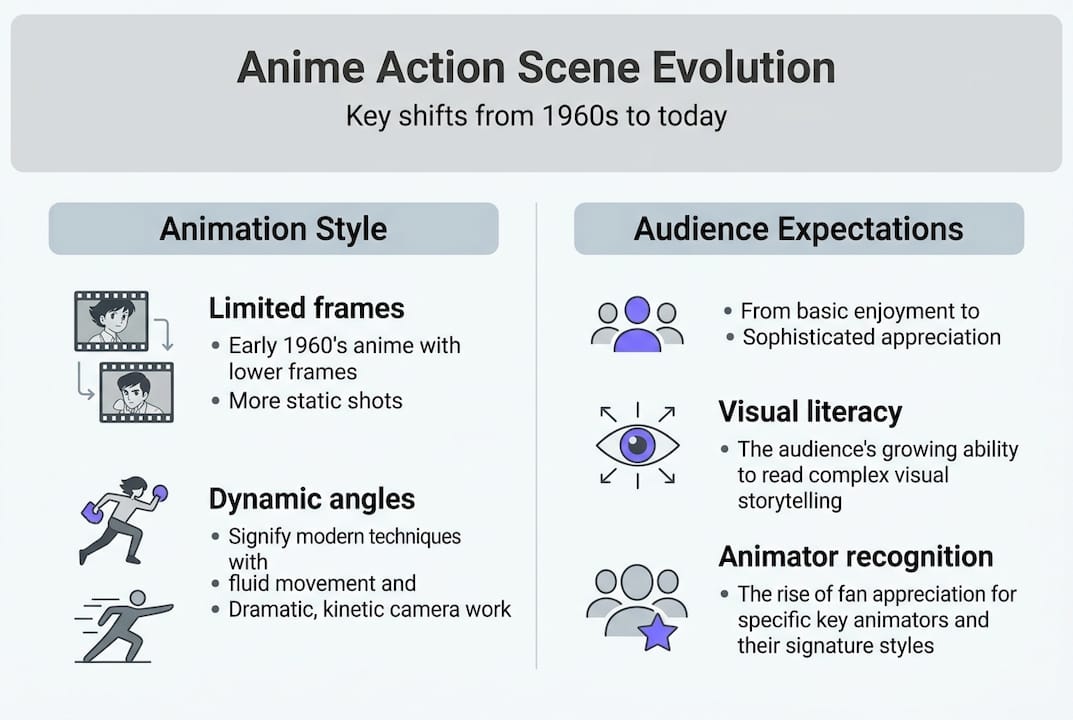
Today, dedicated sakuga appreciation platforms track individual animator contributions scene by scene. Fans know names. They follow careers. A single fluid cut can trend online within hours of airing. That’s a complete transformation from Tezuka’s era, where the director’s name was the only credit most viewers noticed.
Modern audiences are more visually literate than ever. And that literacy raises the creative stakes for studios producing evolving anime scenes.
The uncomfortable truth most fans miss about anime’s visual evolution
Here’s the take that rarely makes it into fan discussions: more sakuga does not mean better anime. In fact, it can mean the opposite.
When every episode pushes toward peak animation, something strange happens. Your brain adjusts. What felt extraordinary at episode three starts to feel expected by episode ten. Budget constraints that balance sakuga with shortcuts are not just financial realities. They’re creative guardrails. Overusing high-impact animation reduces its effect as viewers habituate.
The shows that use evolving scenes most effectively are the ones that earn them. Long stretches of quiet, still, even “cheap” animation build the contrast that makes a sakuga sequence explode. You can explore case studies on anime scenes to see this pattern repeat across titles.
Production constraints have historically forced creative breakthroughs. The limited animation of Tezuka’s era produced a visual vocabulary so expressive it influenced global storytelling. The iconic stillness in Evangelion came partly from budget shortfalls, and it became one of the most discussed stylistic choices in anime history.
The lesson is this: the most powerful evolving anime scenes work because of everything surrounding them, not just their own technical brilliance. Placement, pacing, and earned emotional context turn a great cut into a legendary one.
Deepen your anime experience with WaifuGen
Ready to take your passion for anime to a new level? Now that you understand the craft behind evolving scenes, you can apply that knowledge somewhere surprising.
WaifuGen brings the logic of evolving anime scenes into your personal experience. Characters like Sakura have their own moods, schedules, and visual states that shift based on your interactions. The scenes you generate aren’t static. They respond to emotional context, just like the best anime storytelling does. Explore character dynamics through AI character chat and see how narrative choices shape every interaction. Or jump straight into AI anime chat to experience immersive visual storytelling firsthand. Your understanding of anime just got a powerful new playground. 🎌
Frequently asked questions
What does ‘sakuga’ mean in anime, and why do fans care?
Sakuga describes standout animation scenes that are more detailed and fluid than normal, making major story moments hit harder. Fans care because tracking these scenes reveals the human craft and individual animator talent behind the series.
How do evolving anime scenes tell stories without dialog?
Evolving scenes use visual motifs, silence, and techniques like mono no aware and ma to express emotion and deepen narrative without a single spoken word. Frieren is one of the most celebrated recent examples of this approach.
Why don’t all anime episodes feature sakuga-level animation?
Producing sakuga is expensive and labor-intensive, so studios balance it with animation shortcuts to manage budgets. Overusing it also reduces its emotional impact as viewers adjust to the higher baseline.
How has the approach to anime action scenes changed over time?
Anime action scenes shifted from Tezuka-era limited animation with static shots and dynamic camera work to today’s fluid, frame-dense sakuga that fans track and celebrate online as cultural moments.