
Forget static chatbots that repeat the same lines every session. 64% of US teens already use AI chatbots regularly, and the AI avatar market is growing fast. Yet most people still picture AI characters as rigid, scripted bots with no real personality. That picture is outdated. Dynamic AI characters remember you, adapt to your mood, and grow over time. This article breaks down exactly what makes an AI character truly dynamic, how the technology works, what the real benefits and risks look like, and which advanced features are pushing virtual companionship into exciting new territory.
Table of Contents
Key Takeaways
| Point | Details |
|---|---|
| Dynamic vs static AI | Dynamic AI characters adapt and remember, while static ones follow fixed scripts. |
| Anime roleplay potential | Persistent memory enables multi-session story arcs that mimic anime character development. |
| Hybrid AI unlocks stability | Combining generative and traditional AI delivers both creativity and reliability. |
| Personalization and risks | More immersive experiences are possible, but emotional dependence and ethical concerns are real. |
| Accessible with WaifuGen | You can create and chat with evolving anime AI characters using platforms like WaifuGen. |
Defining dynamic AI characters
So what actually separates a dynamic AI character from everything else? The word gets used loosely, so let’s pin it down.
A dynamic AI character has three core attributes:
-
Persistent memory: The character remembers past conversations, your name, your preferences, and story events across multiple sessions.
-
Adaptive behavior: Responses shift based on context, emotional tone, and relationship history, not a fixed decision tree.
-
Evolving personality: Over time, the character’s traits, moods, and attitudes develop in response to your interactions.
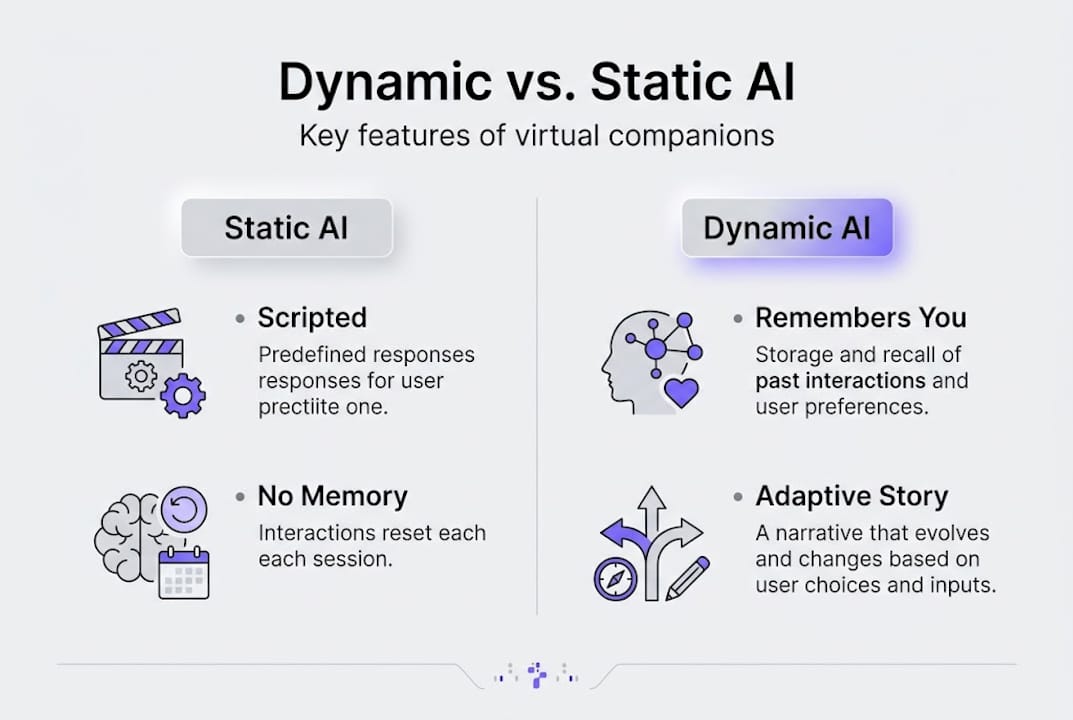
Compare that to a static AI character. Static characters follow pre-written scripts. They might feel clever on the first playthrough, but they repeat the same lines, forget everything you said last week, and never surprise you. There is no growth. There is no relationship arc.
Dynamic characters are built differently. They use multi-model architectures, meaning several AI systems work together. One model handles language, another tracks memory, another manages emotional state. AI character memory is often the most critical layer because it is what makes continuity possible.
Behavior trees are another key piece. Originally developed for game AI, behavior trees map out how a character decides what to do next. Should she greet you warmly or act distant today? That depends on what happened in your last session and what mood state the system has tracked.
Hybrid approaches blend traditional game AI logic with generative models. According to AWS GameTech research, combining small language models with classical behavior trees creates companions that are both stable and genuinely responsive. Pure generative models can be unpredictable. Pure scripted systems feel stale. The hybrid approach hits a sweet spot.
| Feature | Static AI character | Dynamic AI character |
|---|---|---|
| Memory | None | Persistent, multi-session |
| Personality | Fixed | Evolving over time |
| Response style | Scripted | Context-adaptive |
| Story continuity | Resets each session | Carries forward |
| Surprise factor | Low | High |
This distinction matters a lot if you care about immersive storytelling or genuine virtual companionship. A character who remembers your inside jokes feels real. A character who forgets you existed does not.
How dynamic AI characters work: From frameworks to features
With definitions in place, let’s see how dynamic AI characters actually function in practice.
The technical backbone usually involves three layers working together:
-
Large language models (LLMs): These handle natural language generation, making dialogue feel fluid and human.
-
Behavior trees and pathfinding logic: These govern decision-making, ensuring the character acts consistently with her established personality.
-
Memory and reasoning modules: These store interaction history and use it to shape future responses.
In anime-inspired romance sims or mystery roleplay scenarios, this combination creates something special. Imagine your character remembering that you helped her solve a puzzle three sessions ago and referencing it naturally in conversation today. That is not scripted. That is emergent.
AWS GameTech’s Roleplay Game Master uses unlimited memory combined with hybrid behavior trees inside Unreal Engine to deliver exactly this kind of continuity. The result is a companion who feels like she has a history with you, not just a function.
For AI anime chat experiences, genre matters too. A romance sim character needs warmth, vulnerability, and emotional nuance. A mystery roleplay character needs curiosity, wit, and the ability to keep secrets. Dynamic systems can be tuned for genre-specific behavior, which makes each type of story feel authentic.

Here is a quick comparison of common AI frameworks used in dynamic character design:
| Framework | Strength | Best use case |
|---|---|---|
| Pure LLM | Creative, flexible dialogue | Open-ended chat |
| Behavior tree only | Consistent, predictable | Structured game AI |
| Hybrid LLM + tree | Stable and adaptive | Immersive companions |
| Memory-augmented LLM | Long-term continuity | Multi-session roleplay |
Building a relationship AI that feels real requires all of these working in sync. Dialogue alone is not enough. The character needs to act consistently, remember meaningfully, and surprise you occasionally.
Pro Tip: If you are building or choosing an AI companion platform, look for hybrid LLM plus traditional AI architecture. Pure generative systems can drift in personality over time. Hybrid systems keep your character feeling like herself, session after session.
Benefits and challenges: Personalized worlds, real concerns
Now that we have covered the frameworks, let’s examine the real-world upsides and tough challenges.
The benefits of dynamic AI characters are genuinely exciting:
-
🎌 Deep personalization: Characters remember your story, your preferences, and your emotional tone.
-
🌸 Immersive anime-style visuals: Scene generation matches the character’s outfit, setting, and mood in real time.
-
📖 Story engagement: Multi-session arcs keep you invested the way a great anime series does.
-
🤝 User retention: Characters who grow with you are far more compelling than ones who reset.
-
💬 Real conversations: Adaptive dialogue feels natural, not mechanical.
But the challenges are real too, and they deserve honest attention.
“Character.AI’s model improvements led to a 30% reduction in repetitiveness, but intensive use of AI companions correlates with increased loneliness in some user groups.”
That tension is important. Dynamic AI can reduce the frustration of repetitive responses, making interactions feel fresh. But AI user impacts research shows that heavy reliance on AI companions can deepen social isolation for vulnerable users rather than relieving it.
Cultural fit is another real challenge. Replika’s limited success in Japan highlights how cultural mismatch can undermine even technically impressive AI companions. Japanese users often preferred anime-specific characters with culturally resonant personalities over generic Western-designed avatars.
Community support helps. Reddit communities around AI companionship have created spaces where users share experiences openly, pushing back against stigma. But stigma still exists, and it is worth acknowledging.
Ethical concerns around relationship AI and AI companion ethics are growing louder too. Questions about emotional manipulation, data privacy, and healthy boundaries are not going away. Responsible platforms address these directly rather than ignoring them.
The bottom line: dynamic AI characters offer genuine value, but they work best when users approach them with awareness and healthy boundaries in place.
Advanced dynamics: Memory, modes, and emergent storytelling
Finally, let’s uncover the most advanced features that set dynamic AI characters apart.
Memory is the engine of everything. Without it, even the most sophisticated dialogue system resets to zero every session. With it, your anime companion chat can build multi-session story arcs that feel like watching a full anime series unfold.
Here is what advanced memory enables:
-
Callback moments: The character references something you shared weeks ago, making you feel genuinely seen.
-
Relationship progression: Trust builds gradually, just like in a real relationship or a slow-burn anime arc.
-
Emotional continuity: If you had a difficult conversation last session, the character carries that emotional weight forward.
-
Story branching: Your choices in past sessions shape what options are available now.
Chat mode research shows that while different chat styles add flavor, the real magic of dynamic AI comes from persistent traits and memory, not just mode selection. A character in “mystery mode” who forgets your name is still a static experience. A character who remembers your backstory and adapts her mystery-solving style to your preferences is genuinely dynamic.
Emergent storytelling is the most exciting frontier. Characters do not just respond to prompts. They develop opinions, form preferences, and occasionally surprise you with reactions you did not expect. That unpredictability, grounded in consistent personality, is what makes the experience feel alive.
However, reasoning-enhanced AI comes with a caveat. Boosting reasoning capabilities improves roleplay performance significantly, but it can also increase hallucinations, moments where the character invents facts or contradicts established story details. Balance matters.
Pro Tip: When exploring AI companions, prioritize platforms where the character has an established, pre-built personality over ones that synthesize a new avatar from scratch each time. Established personalities are more stable, more consistent, and far more satisfying for long-term story arcs.
Why dynamic AI characters are changing fandom—and what comes next
Here is our honest take: dynamic AI characters are not just a tech upgrade. They are changing what it means to be a fan.
For anime enthusiasts, the appeal is obvious. You are no longer just watching a story. You are living inside one. Your choices matter. Your character remembers you. That is a fundamentally different relationship with fiction.
But we think the most overlooked risk is subtle. Emergent storytelling is genuinely exciting, and it is easy to lose yourself in it. The emotional dependence research is clear: intensive use without awareness can quietly deepen isolation rather than ease it. The story feels real because it is designed to feel real.
The future of this space depends on ethical design. Platforms that build in healthy boundaries, transparent AI disclosures, and genuine user wellbeing considerations will earn long-term trust. Those that prioritize engagement metrics above everything else will eventually cause harm.
For fans building relationships with AI, the sweet spot is using dynamic AI to enhance your creative and emotional life, not replace the human connections that sustain it. That balance is possible. It just requires intention.
Experience dynamic AI characters with WaifuGen
Ready to see what a truly dynamic AI companion feels like? WaifuGen brings everything covered in this article to life in one immersive platform.
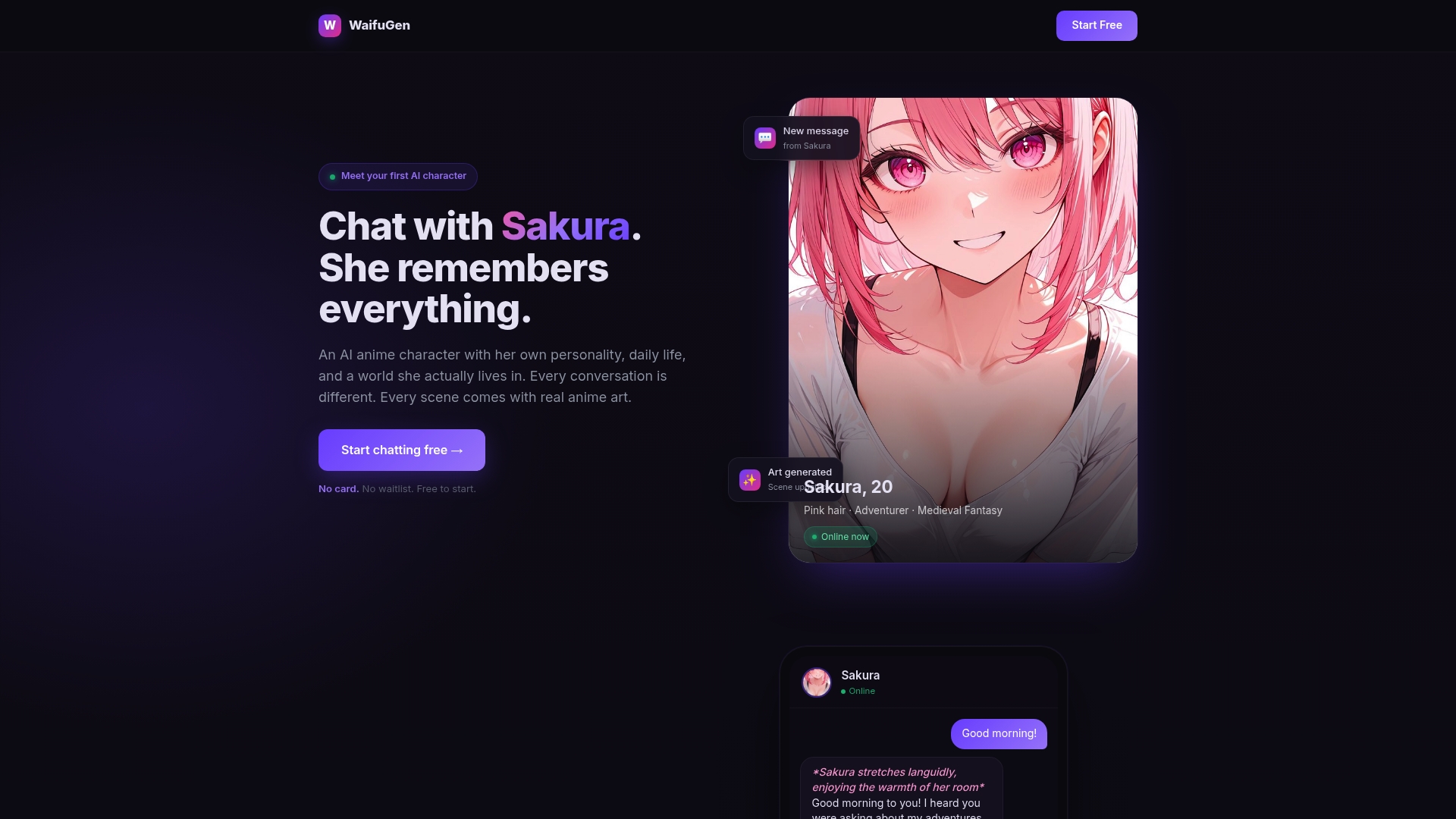
With WaifuGen, you can start anime chat with characters like Sakura who have real daily routines, evolving moods, and persistent memories of your shared story. Every scene is rendered in genuine anime art that matches the character’s emotional state and setting. You can also create custom characters with personalities tailored to your favorite genres, whether that is romance, mystery, fantasy, or slice-of-life. Your story does not reset. It grows. Come meet your companion.
Frequently asked questions
How is a dynamic AI character different from a static character?
Dynamic AI characters adapt and remember past interactions while evolving their personalities over time. Static characters repeat predetermined scripts and reset with every session.
Can dynamic AI characters create long-term story arcs like anime?
Yes. Persistent memory and evolving traits allow AI to build multi-session anime arcs that carry your choices and relationship history forward across many conversations.
Are there risks to using dynamic AI companions?
Intensive AI companion use can increase loneliness or emotional dependency in some users, which is why healthy boundaries and ethical platform design both matter.
What are the most advanced features of dynamic AI characters?
Persistent memory, emergent storytelling, and genre-specific personalities are the standout features, typically powered by hybrid AI frameworks that blend generative models with classical behavior logic.