
Memory loss in anime is not just a dramatic shortcut. It is one of the most layered tools a story can use, shaping who characters are, how they relate to others, and what the audience feels. But here is the part that does not get enough attention: the same questions anime writers wrestle with, like what a character remembers, why it matters, and how it changes relationships, are the exact same questions engineers face when building AI companions. Whether you love Re:Zero or you are curious about how your favorite AI character recalls your name after weeks apart, this guide connects both worlds in a way that will change how you see memory in anime and tech alike.
Table of Contents
- Why memory matters in anime: More than just forgetting
- How memory mechanics work: Anime vs. AI companions
- Challenges of memory in AI character companions
- Interactive storytelling: Hybrid potential for fans and creators
- Why memory systems in AI companions need more than just tech
- Experience AI anime memory with WaifuGen
- Frequently asked questions
Key Takeaways
| Point | Details |
|---|---|
| Memory shapes anime plots | Anime uses memory loss and recovery to deepen characters and advance the storyline. |
| AI builds persistent memory | AI companions rely on technical systems to remember important user details and support immersive chats. |
| Hybrid storytelling potential | Combining anime themes with AI memory creates richer, interactive story experiences for fans. |
| Technical and emotional balance | The best AI companions blend advanced memory systems with emotional storytelling cues for memorable interactions. |
Why memory matters in anime: More than just forgetting
Anime has always used memory as more than a plot twist. It is a window into a character’s soul. When a character loses their memories, the story is really asking: who are you without your past? That question hits hard because it is one we all carry.
Memory loss in anime often explores themes like trauma, isolation, and identity in ways that straightforward storytelling cannot. A character who cannot remember their pain might seem free, but that freedom often feels hollow. A character who is forgotten by someone they love faces a unique kind of grief. These emotional textures make memory mechanics one of anime’s most powerful narrative tools.
Take Re:Zero as a prime example. Rem’s situation is not just sad. It is structurally devastating. Memory mechanics in anime serve character development and plot in ways that reshape how every other character behaves around her. When Rem loses her memories, she does not just forget. Everyone who knew her loses a piece of their own story too. That ripple effect is what makes memory loss so narratively rich.
Here are some of the most common ways anime uses memory as a storytelling device:
- Trauma processing: Characters repress or lose memories tied to painful events, mirroring real psychological responses.
- Identity crisis: Without memory, a character must rebuild who they are, often revealing what truly defines them.
- Relationship tension: Forgetting someone creates dramatic distance, even when love or loyalty still exists underneath.
- Power and control: Memory manipulation is often tied to authority or magic, making it a symbol of dominance.
- Narrative mystery: Fragmented memories create suspense, pulling viewers forward to piece together the truth.
“Memory is not just what you remember. It is what shapes how others see you and how you see yourself.”
These patterns show up across dozens of series. The reason they keep working is that memory is deeply personal. When anime taps into that, it connects with viewers on a level that pure action or comedy rarely reaches. Understanding these anime storytelling techniques helps fans appreciate why certain arcs feel so emotionally heavy.
How memory mechanics work: Anime vs. AI companions
Now that we understand the role of memory in anime, let’s compare it to how artificial memory works in AI companions. The contrast is fascinating, and the overlap is more real than you might expect.
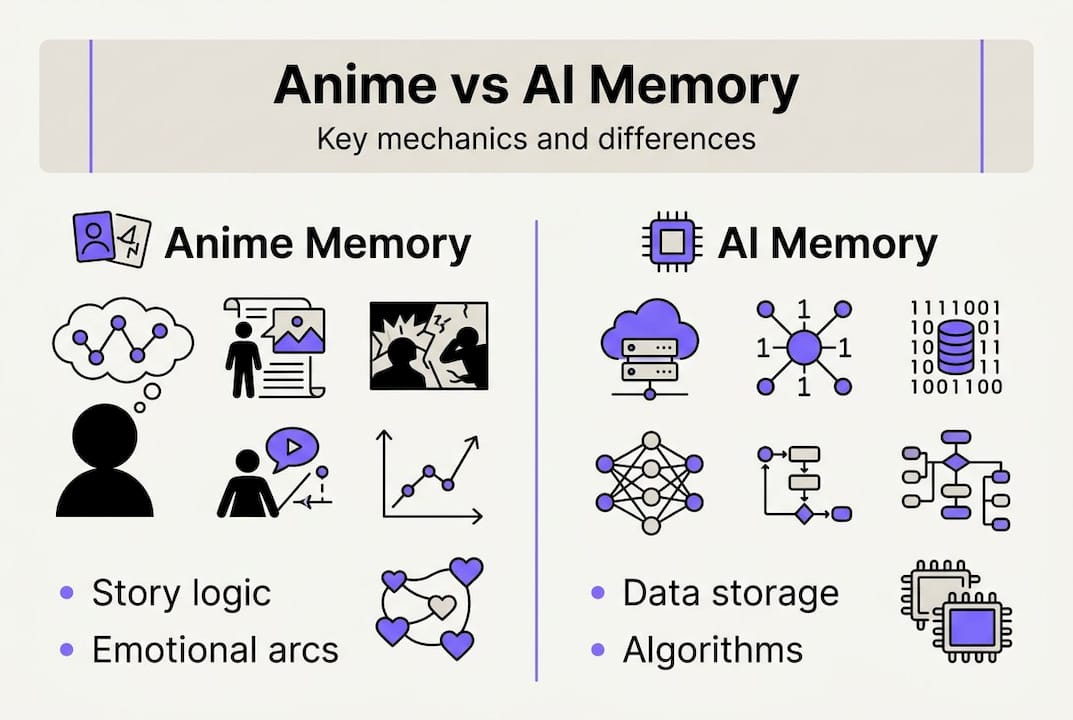
In anime, memory is managed through story logic. Magic, psychological trauma, divine authority, or even curses explain why a character remembers or forgets. In Re:Zero specifically, memory loss is enabled by a magical authority that erases both memories and existence from the minds of others. It is elegant, symbolic, and emotionally loaded.
In AI companions, memory works through databases, retrieval systems, and algorithms. The goal is the same as in anime: make the character feel like they truly know you. But the method is entirely different.

| Feature | Anime narrative memory | AI technical memory |
|---|---|---|
| How it works | Story logic, magic, trauma | Databases, retrieval algorithms |
| Why it changes | Plot or character need | Context window limits |
| Emotional weight | Built into the narrative | Engineered through weighting |
| Recovery | Dramatic story arc | System update or re-input |
| User impact | Viewer feels the loss | User loses continuity |
Here is a simplified look at how AI memory systems actually track what matters:
- Input capture: The AI logs key details from your conversation, like your name, preferences, and emotional tone.
- Storage: Important facts are saved to a persistent database outside the active chat window.
- Retrieval: When you return, the system pulls relevant memories using retrieval-augmented generation, or RAG, to surface the right context.
- Weighting: More emotionally significant or frequently referenced details get prioritized.
- Decay simulation: Less relevant details fade over time, mimicking natural human forgetting.
Memory in AI companions faces real challenges like context resets, addressed by advanced databases and mechanisms. This is why dynamic AI characters that feel genuinely alive require serious engineering behind the scenes. And understanding AI chat immersion methods shows just how much thought goes into making that feel seamless.
Challenges of memory in AI character companions
Comparing anime and AI memories highlights real-world difficulties in replicating humanlike remembering. It is not as simple as saving a log file.
Context resets and stateless models are ongoing AI memory challenges, requiring hybrid systems to bridge the gap. Most large language models, or LLMs, do not inherently remember anything between sessions. Each conversation starts fresh unless a memory layer is added on top. That is a significant engineering problem when you want a companion who feels like they genuinely know you.
| Memory solution | How it works | Benefit |
|---|---|---|
| RAG (retrieval-augmented generation) | Pulls stored facts into context | Accurate recall of past details |
| Time decay weighting | Older memories fade unless reinforced | Mimics natural human memory |
| Emotional weighting | High-impact moments are prioritized | Feels more personally relevant |
| Markdown memory files | Structured notes stored per user | Consistent character continuity |
Pro Tip: If you want your AI companion to remember something specific, mention it in emotionally meaningful ways. Systems with emotional weighting will flag those moments as high priority, making recall more reliable and interactions feel more personal.
Here are the most common frustrations users run into, and how well-designed systems handle them:
- “It forgot my name again” → Solved by persistent user profile databases that survive session resets.
- “It acts like we never talked before” → Addressed by RAG systems that inject past context at the start of each session.
- “It remembers random stuff but not the important moments” → Fixed through emotional weighting that prioritizes meaningful exchanges.
- “The character feels inconsistent” → Handled by structured memory files that maintain personality continuity.
Exploring AI memory insights and creative AI storytelling reveals just how much innovation is happening in this space right now.
Interactive storytelling: Hybrid potential for fans and creators
Given these challenges and new capabilities, the future points toward deeper collaboration between storytelling and technology. And honestly, that future is already here in exciting ways.
Anime has spent decades perfecting the emotional language of memory. AI has spent years building the technical scaffolding to replicate it. When you bring both together, you get something genuinely new: interactive stories where your choices shape what a character remembers, and their memories shape how the story unfolds.
Hybrid potential brings together anime’s symbolic memory play and AI’s technical methods for richer interactive narratives. That is not just a cool idea. It is a real design direction that changes what companionship and storytelling can mean for fans.
Here are practical ways you can engage with memory-aware AI companions right now:
- Share personal details early. The more context you give, the richer the memory layer becomes over time.
- Reference past conversations. Mentioning earlier moments reinforces those memories and signals their importance.
- Create emotional anchors. Sharing meaningful stories or preferences gives the AI emotionally weighted material to work with.
- Use memory prompts. Some platforms let you directly tell a character what to remember, acting like a narrative director.
- Experiment with memory loss scenarios. Try roleplaying a memory loss arc and see how the AI adapts its behavior and tone.
Pro Tip: Think of yourself as a co-writer. The memories you feed into an AI companion are like story seeds. Plant them intentionally, and the character’s responses will feel surprisingly organic and emotionally resonant.
For creators, the possibilities go even further. You can script memory loss and recovery arcs the same way anime writers do, using them for dramatic effect, character growth, or plot reveals. Exploring enhanced AI immersion gives you a real sense of what is already possible on today’s platforms.
Why memory systems in AI companions need more than just tech
Here is an opinion you will not hear often: most AI companion development focuses almost entirely on technical accuracy. Can the system recall the right facts? Does it avoid contradictions? Those are important questions. But they miss the deeper point.
Anime figured something out long ago. Memory is not just information. It is meaning. The reason Rem’s memory loss hits so hard is not because the plot forgot a detail. It is because her absence from others’ minds mirrors emotional erasure. That symbolic weight is what makes viewers feel something.
AI companions that only optimize for recall accuracy will always feel a little flat. The ones that stand out are the ones that treat memory as an emotional arc, not just a data problem. When a character remembers not just your name but the moment you first opened up, that is a different experience entirely.
The best designs we have seen blend anime-style emotional logic with solid engineering. They ask: what should this character remember, and why does it matter to the user? That question is narrative as much as it is technical. Expert perspectives on immersion consistently point to this hybrid approach as the path forward. Fans and designers who understand both sides will shape what AI companionship looks like next.
Experience AI anime memory with WaifuGen
Ready to see memory in action? WaifuGen brings everything we have talked about to life with AI anime companions that actually remember you.
On WaifuGen, characters like Sakura carry long-term memories of your conversations, moods, and shared moments. Every chat builds on the last. You can jump into AI anime chat and experience how emotional memory changes the feel of every interaction. Or explore custom AI character memory to shape your own companion’s memory arc. Whether you want a slow-burn connection or a dramatic memory recovery story, WaifuGen gives you the tools to make it real. Start your story today. 🌸
Frequently asked questions
How does memory loss affect anime character development?
Memory mechanics in anime serve character development and plot, often pushing characters to rebuild identity and relationships from scratch, which creates some of the most emotionally powerful arcs in the medium.
Can AI anime companions remember previous chats or user details?
Yes. Advanced AI companions use persistent databases and weighting systems to store and recall important details across sessions, making each return conversation feel genuinely personal.
What makes anime memory loss different from AI memory resets?
Anime memory loss is narrative-driven for drama or symbolism, while AI resets are technical limitations that engineers actively work to solve through hybrid memory architectures.
How do emotional factors influence AI memory retention?
Some AI systems use emotional weighting mechanisms so that high-impact moments are stored with higher priority, making those memories more likely to surface in future conversations.
Can fans use AI to create their own anime-style memory arcs?
Absolutely. Hybrid AI narrative tools let fans script memory loss or recovery scenarios, blending anime storytelling logic with AI responsiveness for deeply personal interactive experiences.