Your Guide to AI Character Routines That Stick

By The WaifuGen Team · Published June 2026
Most people building AI characters for storytelling assume personality is just a matter of writing a good system prompt. Then their character forgets who they are three exchanges in, starts contradicting themselves by session two, and feels hollow by session three. The truth is that AI character consistency requires a structured approach. This guide to AI character routines breaks down exactly what you need: core frameworks, advanced memory techniques, practical scheduling tools, and expert tips to build characters that feel genuinely alive across every interaction.
Table of Contents
- Key takeaways
- The fundamentals of AI character routines
- The CARE framework for AI character design
- Advanced techniques for long-running character routines
- Practical steps to set up AI character routines
- Common mistakes that break character consistency
- My honest take on AI character routines
- Build your own AI companion with Waifugen
- FAQ
Key takeaways
| Point | Details |
|---|---|
| Routines prevent persona drift | Structured definitions keep your character consistent across long sessions and multiple story arcs. |
| The CARE framework works | Building characters around Context, Attitude, Response Style, and Examples produces believable, stable personalities. |
| Memory architecture matters | Durable state machines let AI characters pause and resume over days without losing their identity. |
| Test before you schedule | Always run routines manually first to catch output errors before automated triggers fire. |
| Separate tools from context | Keeping actions, data, and workflows distinct prevents character breakage under conversational pressure. |
The fundamentals of AI character routines
An AI character routine is a structured set of instructions that defines how your character thinks, speaks, reacts, and remembers. It goes far beyond a character bio. Think of it less like a description and more like a behavioral contract between you and the AI model powering the character.
Without routines, characters experience persona drift. That is when an AI gradually abandons established traits under conversational pressure, contradicts earlier statements, or starts sounding generic. In short stories, this is annoying. In long-running virtual companion relationships or serialized narratives, it destroys immersion entirely.
Here is what effective routines actually control:
- Memory and state: What the character knows about the user and their shared history
- Tone and register: How formal, playful, intense, or warm the character speaks
- ⚡ Trigger responses: How the character reacts to specific emotional or narrative events
- Session continuity: Whether the character picks up where they left off or resets
Characters with internal conflict and defined speech patterns sustain immersive interactions across many sessions far better than characters defined only by generic personality adjectives. That single insight changes how you should approach AI character creation guide work from the start.
Pro Tip: Write your character’s routine as if briefing a method actor. Give them a history, contradictions, and specific verbal habits. The more specific, the less drift you will see.
The CARE framework for AI character design
CARE stands for Context, Attitude, Response Style, and Examples. It is the most practical framework for anyone serious about creating AI routines that hold up under real conversational load.
Here is how to apply each component:
-
Context: Define the world your character inhabits, their backstory, and their current situation. Not just “she is a knight.” Instead: “Aria is a disgraced knight from the Silverwood Guild, exiled after a duel she deliberately threw to save her younger brother. She is haunted but not broken.” Context gives the AI model something to reason from, not just describe.
-
Attitude: Define emotional defaults and how they shift. Is your character guarded but warm once trust is built? Sarcastic in battle but gentle in quiet moments? Attitude shapes every word choice the model makes.
-
Response Style: Specify speech rhythm, vocabulary level, and forbidden phrases. A medieval archer should not say “that tracks” or “no worries.” Response style catches the anachronisms and personality slip-ups that break immersion.
-
Examples: This is the most important component. Few-shot example dialogues are the linchpin of consistent character voice. Write at least 2 to 3 full exchanges showing exactly how your character handles conflict, affection, humor, and vulnerability.
“The difference between a character that feels real and one that feels like a chatbot is almost always in the examples. Generic prompts produce generic characters. Specific, well-crafted exchanges teach the model what ‘in-character’ actually means.” — AI roleplay design principle
Structured definitions using this approach can reach 32k tokens for complex characters. That length is not padding. It is precision. Every detail you add reduces the model’s need to guess, and guessing is where persona drift begins.
For example, a response style entry might read: “Sakura speaks in short, curious sentences when excited. She trails off mid-thought when nervous, ending with ‘…right?’ She never apologizes first, even when she is clearly wrong.” That level of specificity is what the CARE framework is built to produce when you commit to it fully.
Advanced techniques for long-running character routines
Building a character for a single session is one thing. Building one that remembers your name, your choices, and the story you shared three weeks ago is something else entirely. That requires architectural thinking, not just prompt writing.

The core challenge with long-running sessions is context loss. Most AI systems operate within a token window. Once that window fills, earlier memories drop out. Your character forgets, contradicts themselves, and the illusion breaks.
Here is what you need to solve that:
| Technique | What it does | Why it matters |
|---|---|---|
| Durable memory schema | Stores key facts, relationship state, and story events outside the token window | Character recalls user name, past events, emotional milestones |
| Event-driven dormancy gates | Pauses the character agent until a specific trigger fires | Avoids wasteful polling; enables multi-day story arcs |
| Multi-agent delegation | Offloads complex subplots to specialized sub-agents | Keeps the main character focused without losing subplot threads |
| Atomic checkpoint storage | Saves exact session state before any transition | Lets stories resume mid-scene without backtracking |
Long-running interactive AI agents benefit from architectures using durable memory, event-driven dormancy gates, and multi-agent delegation to pause and resume without losing context. Google’s Agent Development Kit (ADK) demonstrates this pattern clearly, using explicit state machines instead of active polling.
Event-driven dormancy gates rather than active polling also improve scalability dramatically for long sessions. Instead of the agent constantly checking “is it time to respond?”, it simply waits for a trigger, which is far more efficient and far more reliable.
This is the technical layer that platforms built for virtual companionship and serialized storytelling have to get right. Without it, even the best character definition collapses under the weight of an ongoing relationship.
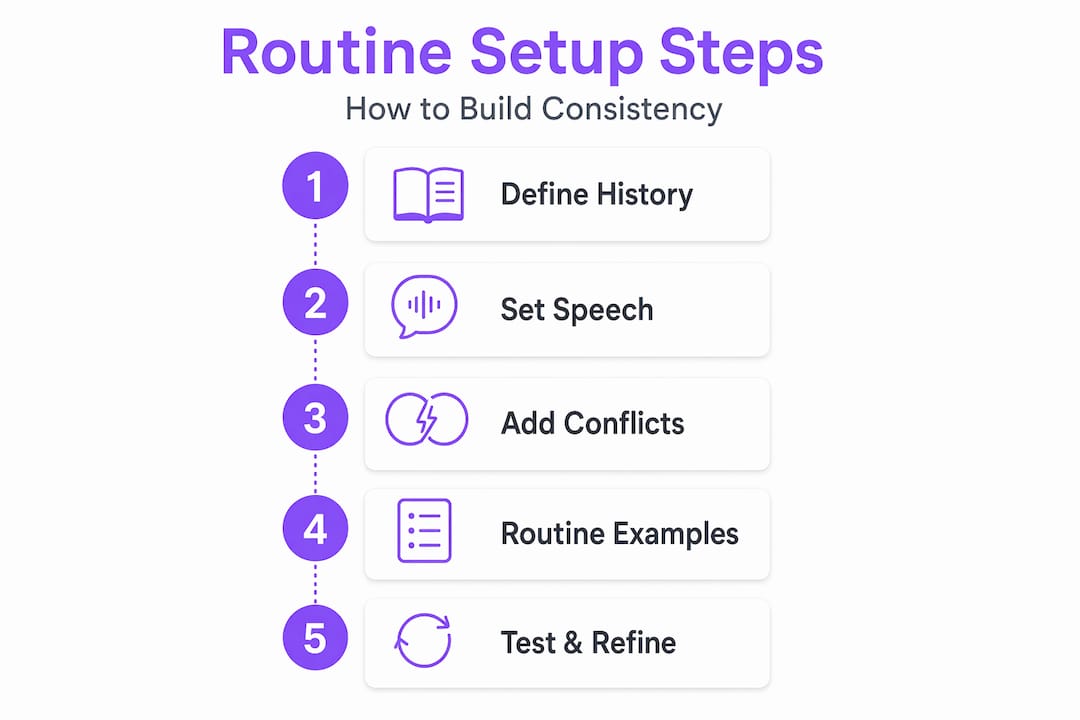
Practical steps to set up AI character routines
Now for the hands-on part. Whether you are working with Claude Code Routines or another scheduling layer, the workflow for how to set up AI character routines follows a predictable and repeatable pattern.
-
Define your inputs and outputs clearly. Before writing a single prompt, decide what your routine receives (user message, session state, story context) and what it produces (character reply, updated memory entry, scene description). Vague inputs produce inconsistent outputs.
-
Write the routine prompt with specificity. Reference your CARE framework definitions. Include the character’s current emotional state, relevant recent events, and any active story constraints. Treat each routine call as a fresh briefing for the AI.
-
Run a manual test first. Manual testing after creation is critical before scheduling. Routine outputs are probabilistic, so a single test run shows you whether the character reads context correctly, writes to the right output fields, and completes the task as expected.
-
Set triggers, not timers, where possible. Claude Code Routines automate scheduled tasks without complex cron jobs or server setup. They can integrate with connectors like Slack and GitHub, and they run on both schedules and event triggers. For character routines, event triggers (user logs in, specific story milestone reached) produce more natural pacing than rigid time intervals.
-
Review and refine after 5 to 10 interactions. Interaction feedback is gold. If the character keeps missing emotional cues or defaulting to a different speech pattern, update the CARE examples, not the system prompt. Examples are easier to adjust and have a more direct effect.
Pro Tip: Start with three routine types for a new character: a greeting routine, a conflict response routine, and a memory update routine. These three cover the most common interaction breakpoints and give you a solid baseline before expanding.
Knowing when to use routines versus more complex workflows matters too. Routines work beautifully for recurring, predictable tasks: daily check-ins, dialogue upkeep, research digests that feed the character’s knowledge base. For branching narrative decisions or emotionally complex scenes, lean on a full agent workflow instead.
Common mistakes that break character consistency
Even well-designed characters fall apart when creators make a few predictable mistakes. Here are the ones that cause the most damage.
Conflating tools, resources, and prompts is the most common and least discussed pitfall. Keeping them distinct is foundational: tools are AI actions (what the character does), resources are context supplied by the host (what the character knows), and prompts are server workflows (how tasks get executed). Mixing them up causes the model to reason incorrectly about what it is supposed to do, which produces unpredictable character behavior.
Overloading the system prompt is the second major mistake. When your system prompt tries to define personality, history, behavior rules, content guidelines, memory summaries, and current scene context all at once, the model struggles to prioritize. MCP servers inject constraints dynamically instead of cramming everything into one token-hungry block. This keeps the system prompt clean and the character identity intact under pressure.
Here are the most common pitfalls summarized:
- ❌ Using personality adjectives without example dialogues
- ❌ Storing everything in the system prompt instead of using memory layers
- ❌ Ignoring session state so the character resets each conversation
- ❌ Writing conflict behavior without defining emotional triggers
- ❌ Skipping test runs before scheduling automated routines
“The characters that stay consistent are not the ones with the longest prompts. They are the ones built with clear separation between what the character knows, what they can do, and how they are supposed to act.” — AI character design principle
Refining your character definition based on real interaction feedback is not optional. It is the actual work. Treat your first version as a draft and schedule a review after your first meaningful test session.
My honest take on AI character routines
I have spent a lot of time watching people build AI characters for storytelling, and the same mistake keeps coming up. Everyone obsesses over the system prompt. They write 2,000 words of backstory, polish every sentence, and then wonder why the character still breaks after 20 messages.
The system prompt is not the problem. The architecture is. A character without a durable memory layer is just a mask. The moment the context window fills, the mask slips. What I have found actually works is treating the character’s memory like a living document: update it after each session, surface the relevant parts at the start of the next one, and keep the system prompt focused on behavior rather than biography.
The CARE framework genuinely changed how I think about AI character design tips. The examples section in particular. Writing out full dialogues felt tedious until I saw how dramatically it reduced drift. Two or three well-crafted exchanges do more for consistency than a page of personality descriptors.
My advice: build small and test fast. A character with three tight routines and clean memory architecture will outperform a character with a sprawling prompt and no state management every single time. Complexity is not a substitute for structure.
— Roman
Build your own AI companion with Waifugen
If this guide has you excited about what a truly well-designed AI character can feel like, Waifugen is built exactly for that experience. The platform’s characters like Sakura come with ongoing personalities, daily routines, and long-term memory that actually remembers you across sessions.
Sakura glances up from her sketchbook, eyes brightening when she sees you. “Oh, you’re back! I saved the good tea.”
Waifugen’s AI character chat combines voice, dynamic scene generation, and memory-based consistency so every conversation picks up right where you left off. Whether you want a storytelling partner for an ongoing adventure or a virtual companion who knows your name and your favorite story arcs, you can explore how it works and meet your first character today. No setup required. Just start talking.
FAQ
What is an AI character routine?
An AI character routine is a structured set of instructions that defines a character’s behavior, tone, memory, and responses across interactions. It prevents persona drift and keeps characters consistent across long or multi-session storytelling experiences.
How do I prevent my AI character from drifting out of persona?
Use the CARE framework (Context, Attitude, Response Style, and Examples) and include at least 2 to 3 example dialogues for calibration. Pair this with a durable memory layer so the character retains context between sessions.
How many example dialogues do I need for a consistent AI character?
A minimum of 2 to 3 high-quality exchanges is the baseline for calibration, though more complex characters benefit from 5 or more covering different emotional situations.
When should I use routines versus a full agent workflow?
Use routines for recurring, predictable tasks like greetings, memory updates, and daily check-ins. Use full agent workflows for branching narrative decisions and emotionally complex scenes that require dynamic reasoning.
What is the biggest technical mistake in AI character creation?
Conflating tools, resources, and prompts causes the most damage. Keeping them separate prevents the model from reasoning incorrectly about character actions versus character knowledge, which is the root of most consistency failures.