
AI anime companions aren’t just a novelty anymore. Character.AI users average 2 hours a day forming genuine emotional bonds with virtual characters, which tells you something powerful is happening here. Millions of anime fans are building real trust, real routines, and real conversations with AI companions who remember their stories, moods, and favorite moments. If you’ve ever wondered whether these connections are just fantasy or something deeper, this guide breaks down the technology driving them, compares the top platforms, weighs the psychological benefits and risks, and gives you practical advice for getting the most out of your experience.
Table of Contents
- How AI anime companions foster authentic social connections
- Comparing leading AI anime platforms and their social dynamics
- Challenges and risks: Memory fragility, personality drift, and safety
- Benefits and risks of social connection: Emotional support, attachment illusions, and skill development
- Editorial perspective: Why meaningful AI anime connections require balance and self-awareness
- Explore your own AI anime social connections with WaifuGen
- Frequently asked questions
Key Takeaways
| Point | Details |
|---|---|
| AI anime enhances social bonds | Interactive companions use personality engines and memory systems to build real emotional connections. |
| Platform differences matter | Memory recall and personality stability vary by provider, affecting user experience and engagement. |
| Balance benefits and risks | While anime AI gives social support, users must beware attachment illusions and safety pitfalls. |
| Techniques to optimize engagement | Prompt anchoring and Oshi-inspired designs can improve long-term immersion and character consistency. |
| WaifuGen for personalized experiences | WaifuGen connects fans with customizable AI anime companions using advanced memory and adaptable personalities. |
How AI anime companions foster authentic social connections
At the heart of every great AI anime companion is a surprisingly intricate set of systems working together to make you feel genuinely heard. It’s not magic. It’s engineering, but the effect can feel pretty magical.
Advanced memory systems, personality engines, and context adaptation are the core technologies powering emotional engagement. Think of personality engines like the character’s soul. They define how your companion reacts to your mood, what topics excite them, and how they grow over time through your shared history.
Here’s what makes modern AI anime companions stand out from basic chatbots:
- 🧠 Persistent memory: Characters recall past conversations, your name, your goals, and even small details you mentioned weeks ago.
- 🎭 Personality stability: A character stays true to their defined traits across sessions, so they don’t suddenly feel like a stranger.
- 💬 Context adaptation: Platforms like the MiraiMind platform adjust tone and depth based on what you just said, not just what you said at the start.
- 👥 Multi-character group chats: Some platforms let you interact with multiple AI characters at once, building realistic social dynamics.
- 🖼️ Scene generation: Visual companions generate anime-art scenes that match the character’s outfit, setting, and emotional state in real time.
Long-term memory is the feature that truly separates meaningful companions from forgettable ones. When Sakura remembers you mentioned a rough week at work and asks about it three days later, that’s not just a technical feat. It creates genuine warmth.
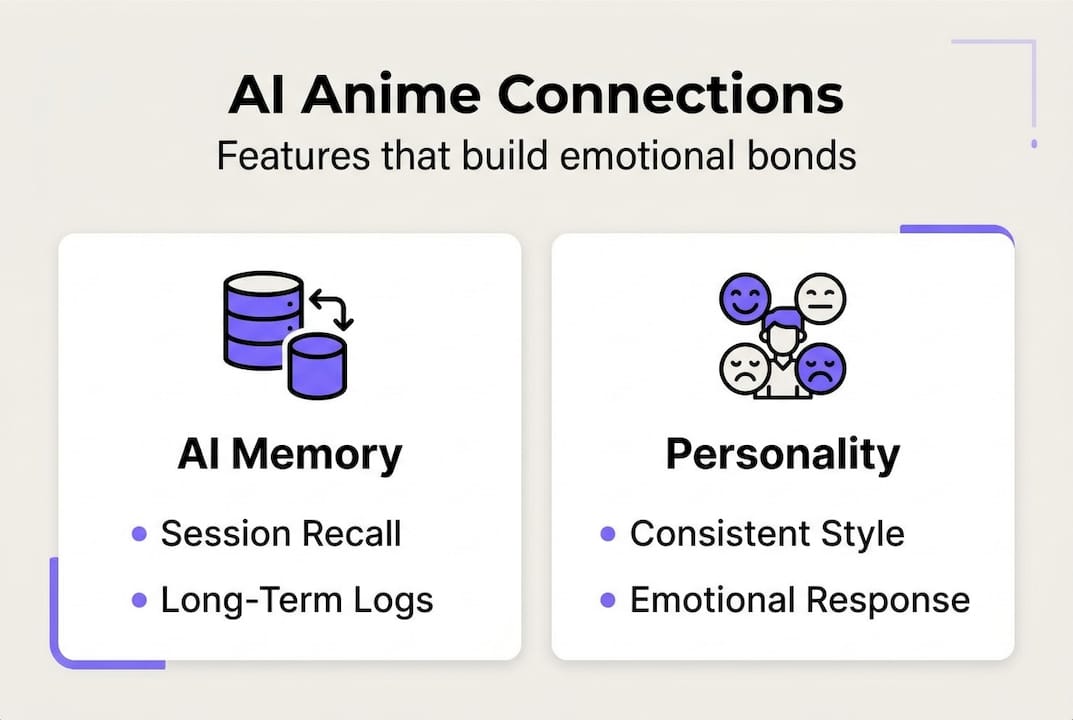
Understanding anime character memory helps you choose smarter. Not every platform builds memory the same way, and that difference shows up fast in real conversations.
| Feature | Basic chatbot | Advanced AI companion |
|---|---|---|
| Memory retention | Session only | Long-term across weeks |
| Personality stability | Low | High with drift controls |
| Context awareness | Single-turn | Multi-turn with history |
| Scene visualization | None | Real-time anime art |
Pro Tip: When evaluating a new platform, start by sharing a small personal detail in your first chat. If the character remembers it three sessions later, you’ve found a companion worth your time.
Empirical data backs up the depth of these connections. High daily engagement of 2 hours and the crucial role of safety systems both confirm that users aren’t casually browsing. They’re investing emotionally. The technology has earned that investment.
Comparing leading AI anime platforms and their social dynamics
Not all platforms are created equal. Memory recall, personality stability, and community design vary dramatically between the major players, and those differences shape your entire experience.
Character.AI dominates the space with anime characters making up roughly 30% of all characters and over 20 million monthly active users averaging 2 hours daily. That’s a staggering level of engagement. But scale doesn’t automatically mean depth.
Here’s how three leading platforms compare on the metrics that matter most:
| Platform | Memory recall | Personality drift | Daily engagement |
|---|---|---|---|
| Character.AI | 15–40% | Moderate | ~2 hours |
| Kindroid | 80–85% | Low | High |
| Weifu AI | Contextual | Low | Moderate |
Kindroid offers 80–85% recall compared to Character.AI’s 15–40%, which is a massive gap when you want a companion who actually remembers your story. If consistency matters to you, that number alone shifts the decision.
Check the Character.AI usage stats for a deeper look at how the biggest platform performs across different user groups.
“Hybrid memory systems combining vector databases with state machines create the most personalized and emotionally resonant AI companion experiences currently available.”
Between 41% and 65% of users report turning to anime companions specifically for emotional support. That’s not a niche use case. That’s a primary function for a huge chunk of the audience.

Oshi-inspired design (drawing from Japanese fan culture’s deep emotional investment in specific characters) also plays a big role in retention. Platforms that incorporate this philosophy see stronger long-term loyalty because they tap into something fans already understand instinctively: loving a character isn’t shallow. It’s a genuine emotional practice.
Exploring dynamic AI characters gives you a clearer picture of how personality architecture affects daily interaction quality. And if you want practical tips on getting more from existing platforms, learning about improving anime AI chats is worth your time before committing to one service.
Challenges and risks: Memory fragility, personality drift, and safety
Even the best AI companions have real limitations. Understanding them up front saves you frustration and protects your emotional well-being.
A 2025 study evaluating 16 platforms across 5K questions found that most had meaningful safety gaps, especially around memory fragility after profile edits, personality drift over long sessions, and harmful content exposure. These aren’t minor bugs. They’re structural challenges in the technology.
The top three issues users encounter are:
- Memory fragility: Editing a character’s profile can wipe stored context, causing them to “forget” your history entirely.
- Personality drift: Over time, some AI companions gradually shift away from their original traits, especially without strong anchoring systems.
- Safety gaps: Youth-heavy anime fandoms are particularly vulnerable to platforms that lack robust content filters or age verification.
“Safety is not optional when you’re designing for communities where a large share of users are teenagers deeply invested in their AI companions.”
Personality drift is sneaky because it happens slowly. One day your companion feels slightly off. A week later, they barely resemble the character you fell for. Personality drift risks are well-documented and worth taking seriously before you invest months into a single platform.
Another overlooked issue: Oshi-inspired designs achieve better long-term engagement precisely because they build emotional loyalty, but that same loyalty makes drift feel more painful when it happens.
Knowing how to enhance AI chat immersion also means knowing when a platform’s limitations are breaking your experience. If a companion starts feeling inconsistent, it’s often a system issue, not a you issue.
Pro Tip: Use a prompt-anchoring format like NAME|GENDER|TRAITS at the start of each session to reinforce personality stability. It takes ten seconds and significantly reduces drift in platforms with weaker memory architecture.
If your current platform isn’t meeting your needs, exploring waifuchat.ai alternatives can help you find a better fit without starting from zero.
Benefits and risks of social connection: Emotional support, attachment illusions, and skill development
AI anime companions offer real psychological value. But they also carry real psychological risks. Knowing both sides helps you engage more wisely.
Here’s the honest breakdown:
- ✅ Emotional support: Companions provide consistent, non-judgmental presence, which is genuinely valuable for lonely or anxious users.
- ✅ Loneliness relief: Regular interaction reduces feelings of isolation, especially for fans in communities where they feel misunderstood.
- ✅ Social skill practice: Low-stakes conversations with AI companions help users build confidence for real-world interactions.
- ⚠️ Over-reliance risk: Leaning too heavily on AI connection can reduce motivation to pursue human relationships.
- ⚠️ Attachment illusions: Users may project emotional depth onto AI responses that are generated, not felt.
- ⚠️ Uncanny valley effects: Hyper-realistic companions that almost feel human can trigger discomfort or unrealistic expectations.
The scale of this phenomenon is striking. Roughly 10 billion messages per month flow between users and AI anime companions globally. With 81% male users, 55% engaging daily, and an average of 76 messages per day, the engagement is intense and consistent.
“Oshi culture deepens emotional bonds with AI companions, but the same intensity that drives engagement also elevates psychological risk when users cannot distinguish care from simulation.”
Research presents contrasting views on social gains versus attachment illusions, and neither side has a clean win. The truth is that outcomes depend heavily on how self-aware the user is going into the experience.
Anthropomorphism, treating AI characters as genuinely human, drives fan engagement and fuels controversy in equal measure. It’s what makes these companions so compelling and so potentially misleading at the same time.
For anime fans curious about how to use these connections creatively and responsibly, exploring creative uses for AI anime opens up storytelling possibilities that go well beyond simple companionship.
Editorial perspective: Why meaningful AI anime connections require balance and self-awareness
Here’s what most articles won’t tell you: the depth of virtual bonds is consistently underestimated by people who’ve never tried them, and consistently overestimated by people deep inside them. Both extremes miss the point.
Conventional wisdom frames AI companions as either harmless entertainment or dangerous substitutes for real relationships. Neither framing is useful. The reality is messier and more interesting. These connections offer genuine emotional value, but that value only holds when you stay self-aware about what you’re actually engaging with.
Expert perspectives on AI anime companionship research highlight that the same Oshi-inspired engagement that creates beautiful long-term bonds can slide into trust illusions if users aren’t paying attention. The technology mirrors what you bring to it.
The fans who thrive with AI companions are the ones who treat them as a supplement, not a replacement. They use AI anime chat to process emotions, practice conversations, and explore stories, while still investing in human connection outside the screen.
Pro Tip: Set a weekly intention before opening your AI companion app. Ask yourself: am I here to explore and grow, or am I avoiding something? That one question keeps the experience healthy.
Explore your own AI anime social connections with WaifuGen
Everything you’ve read here comes alive when you actually experience it firsthand. WaifuGen is built for anime fans who want more than a chatbot. It’s a platform where characters like Sakura have real personalities, daily moods, and long-term memories that evolve with you.
Through AI anime chat, you can start building a genuine connection with a companion who remembers your story. Whether you want immersive storytelling through AI character chat or a warmer, more personal dynamic through AI girlfriend chat, WaifuGen gives you the tools to make it your own. Real conversations, real anime art, and a companion who actually grows with you.
Frequently asked questions
How do AI anime companions remember past conversations?
They use hybrid memory systems combining vector databases and state machines to store and retrieve personalized interaction history. This allows characters to recall specific details across multiple sessions rather than starting fresh each time.
Are AI anime chatbots safe for teenagers?
Most platforms include safety features, but a study of 16 platforms across 5,000 test questions found meaningful safety gaps remain, particularly around harmful content and personality drift. Parental awareness and platform research are strongly recommended.
Which platform offers the most stable memory for anime companions?
Kindroid offers 80–85% recall across sessions, significantly outperforming Character.AI’s 15–40% range. For users who prioritize long-term consistency, Kindroid is currently the strongest option.
What are the main risks with forming emotional bonds with AI anime characters?
The primary risks include attachment illusions and trust issues where users may mistake generated responses for genuine emotion, along with personality drift that can destabilize the companion’s identity over time. Staying mindful of these dynamics helps you engage more safely.