What Is Interactive Anime Narrative? A Clear Guide

By The WaifuGen Team · Published June 2026
Most people assume interactive anime narrative is just regular anime with a few choice menus dropped in. That assumption undersells it by a lot. What is interactive anime narrative, really? It’s a storytelling format where your decisions actively shape character relationships, story direction, and emotional outcomes, all wrapped in anime visuals and world-building. The result is something fundamentally different from watching a show. You’re not an observer. You’re a participant, and the story knows it.
Table of Contents
- Key takeaways
- What is interactive anime narrative, really?
- Technical methods and AI in crafting interactive anime narratives
- How user choices shape character development
- Comparing interactive anime narrative formats
- Future trends and tips for engaging with interactive anime
- My honest take on where this format is going
- Experience interactive anime narrative with Waifugen
- FAQ
Key takeaways
| Point | Details |
|---|---|
| User agency drives the story | Your choices create branching paths, multiple endings, and personalized character relationships. |
| AI makes narratives truly responsive | Persistent memory and AI systems let characters adapt to your history across sessions, not just within one scene. |
| State management powers believability | Behind-the-scenes variables track your choices to prevent the “illusion of choice” problem in branching stories. |
| Format shapes the experience | Visual novels, AI roleplay, and hybrid modes each offer different levels of interactivity and narrative control. |
| Emotional engagement is the real payoff | Meaningful choices increase replayability, emotional stakes, and your connection to the characters. |
What is interactive anime narrative, really?
At its core, interactive anime storytelling is a format where the audience has agency. Instead of a fixed sequence of events, the story branches based on what you choose to do, say, or prioritize. Think of it less like watching Demon Slayer and more like being a character inside it, where your conversation with Tanjiro actually changes what happens next.
The building block of this format is the branching narrative. Rather than one linear plot thread, branching narratives create multiple story paths, each triggered by user decisions. Some paths converge back to a shared story beat. Others lead to wildly different endings. The result is a story that feels personal because it literally adapts to you.
Here’s what typically makes up an interactive anime narrative:
- Branching dialogue trees where your word choice changes how a character feels about you
- Relationship flags that track intimacy, trust, or conflict levels with specific characters
- Scene unlocks tied to prior decisions, revealing new art, music, or story details
- Multiple endings that reward different playstyles or emotional investment
- AI-driven responses in more advanced systems, where the story reacts to free-form input rather than preset options
The blend of animation and text-based choice mechanics is what separates interactive anime from both standard anime and text games. You get the visual richness of anime art style, the emotional weight of voice acting and music, and the personal stakes of a story that only exists the way it does because you played it. That combination is genuinely unique in entertainment.
What is an animated visual novel? It’s one of the most recognizable formats in this space. Games like Clannad or Steins;Gate use animated cutscenes alongside text and choice menus to create story experiences that feel cinematic but remain interactive. They’re one entry point into a much larger format category.
Technical methods and AI in crafting interactive anime narratives
Understanding how these stories are built helps you appreciate how much work goes into making them feel natural. There are three main approaches to narrative design in this space, and each comes with its own trade-offs.
- Emergent narrative gives the story system freedom to generate outcomes from simulated rules, much like a sandbox world where character behavior creates unexpected plots. It’s highly responsive, but can produce incoherent story arcs if left unchecked.
- Reactive narrative pre-scripts story responses to specific triggers. Your choice unlocks a pre-authored scene. It’s coherent and controlled but can feel predictable once you understand the system’s limits.
- Centralized narrative planning uses a story director or AI planner to maintain plot logic while still responding to user input. Hybrid narrative models are the most promising approach because they combine the responsiveness of emergent systems with the coherence of authored structures.
Modern AI-driven interactive anime platforms push this even further. Rather than selecting from preset dialogue options, you can type freely, and the AI adapts in real time. Persistent memory systems allow characters to remember what you said three sessions ago, carry emotional context forward, and build relationships that feel genuinely continuous over time.
One underrated technical tool is the storylet. Used in visual novel engines, storylets dynamically select story units based on your current in-game state. Rather than scripting every possible path by hand, creators define modular story beats with conditions. The engine picks the right beat for the moment. This makes large-scale branching stories far more manageable to build, and far richer for the player.
For creators, tools like ink-based story engines compile narrative state into APIs that handle variables, flags, and choice logic. They are what allow a choice you made in Chapter 1 to quietly influence a scene in Chapter 8 without you realizing it until the payoff lands.
Pro Tip: If you’re learning how to create interactive anime, start by mapping your story’s state variables before writing a single line of dialogue. Knowing what the story needs to track, trust levels, past decisions, unlocked memories, prevents logic breaks that destroy immersion later on.
How user choices shape character development
This is where interactive anime narrative separates itself from every other storytelling format. The choices you make don’t just change plot events. They change who characters become in relation to you.
State management is the engine behind believable character arcs. Every time you make a meaningful choice, the system updates variables in the background. Trust increases. Resentment builds. A character remembers that you defended them when no one else did. Consistent variable tracking prevents the “illusion of choice” problem, where decisions feel meaningful but actually change nothing. When done right, the story reflects your choices in ways that feel earned.
“Player engagement and sense of agency improve significantly when choices have clear narrative consequences.” — Narrative design research, SAE UK
The cascading effect is what makes this so compelling. A single early decision, like choosing to trust a suspicious character or pushing someone away during a vulnerable moment, can redirect the entire emotional arc of the story. Relationships don’t just flip between “good” and “bad.” They deepen, fracture, and rebuild in ways that mirror how real relationships actually work.
This is also why replayability is such a core feature of the format. Multiple endings increase engagement because players want to see what happens when they make different calls. But more than that, replaying feels like getting to know the characters from a completely different angle. You’re not just optimizing for a better outcome. You’re genuinely curious about who these characters are when you treat them differently.

Learn more about this dynamic on the AI companion process breakdown from Waifugen’s blog, which walks through how AI characters sustain these evolving arcs across real interactions.
Comparing interactive anime narrative formats
Not all interactive anime storytelling is built the same. The format you engage with dramatically shapes how much agency you have and how the narrative unfolds.
| Format | Interactivity level | Narrative control | Best for |
|---|---|---|---|
| Visual novel | Medium | High (author-controlled) | Deep story with clear emotional arcs |
| AI roleplay platform | High | Dynamic (AI-mediated) | Open-ended character interaction |
| Hybrid read/watch mode | Low to medium | High | Cinematic story with light choices |
| Social simulation engine | High | Procedural | Relationship-driven emergent stories |
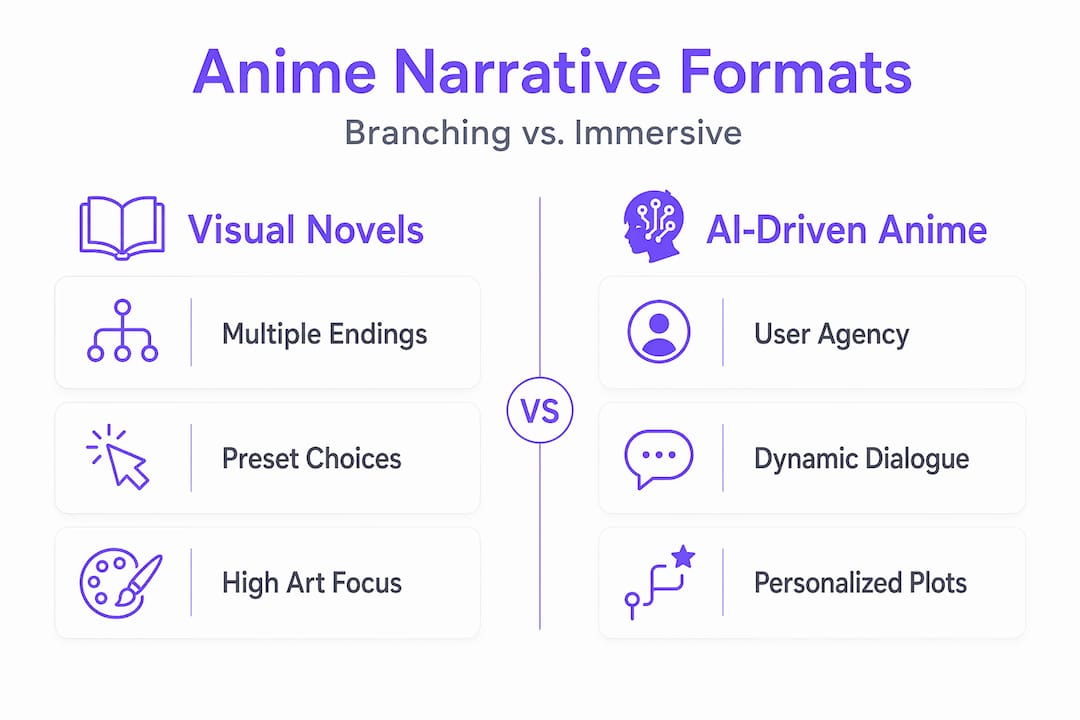
Visual novels are the most established format. They offer carefully authored plots, high-quality art, and branching paths. The trade-off is that your freedom is limited to the options the author wrote. AI roleplay platforms flip that equation. You have far more freedom, since you can say anything, but the narrative coherence depends heavily on how well the AI maintains character and story context.
Hybrid read/watch modes, like those explored in some recent interactive anime experiments, let you switch between animated scenes and text-driven choice sequences. This keeps the cinematic feel while introducing decision points that affect story direction. It’s a newer approach, and the format is still finding its footing.
For users, the choice of format depends on what you value most. If you want a tightly crafted story with a powerful emotional payoff, a visual novel is hard to beat. If you want to actually talk to a character, build a real relationship over time, and have them remember you, an AI roleplay platform gives you something a visual novel never can.
Future trends and tips for engaging with interactive anime
The next wave of interactive anime narrative is being driven by three things: better AI memory, more expressive character art generation, and tighter integration between story scripting and real-time dialogue. Check out Waifugen’s breakdown of AI anime trends and future possibilities for a broader look at where this is heading in 2026 and beyond.
For creators exploring how to create interactive anime, the biggest pitfall is overcomplicating the branch structure too early. Start with two to three meaningful choices that have real consequences, then expand. Too many early branches and the story becomes impossible to maintain with quality. Quality beats quantity every time in engaging anime plot structures.
For users, the tip is simpler. Lean into the emotional stakes. Don’t treat choices like optimization puzzles. The format rewards players who engage with it the way they’d engage with a real relationship, with curiosity, honesty, and willingness to take emotional risks.
Pro Tip: When engaging with AI-driven interactive anime, share specific personal details and preferences with the character early. The more context the AI has, the more personalized and emotionally resonant the story becomes across sessions.
What is interactive narrative at its best? It’s a story that couldn’t exist without you specifically in it.
My honest take on where this format is going
I’ve spent a lot of time thinking about interactive anime narrative, both as a consumer and as someone who watches the technology evolve. The most common misconception I keep running into is that interactivity somehow dilutes the storytelling. People assume that because the story bends to accommodate you, it must be shallower than a fixed narrative.
That’s wrong. And it misses the point entirely.
The most powerful moments I’ve encountered in interactive anime didn’t come from authored cinematic scenes. They came from choices I made that felt genuinely difficult, and from characters who responded in ways that felt earned based on our shared history. That emotional weight is only possible because the story remembered who I was in it.
The real challenge in this space isn’t technical. Building branching logic and AI memory pipelines is solvable. The harder challenge is emotional authenticity. Making characters feel like they have genuine interiority, that their responses come from something real inside them rather than a reactive script, that’s where most platforms still fall short.
What gives me confidence in the format’s future is that the gap between “technically interactive” and “emotionally convincing” is closing fast. AI models are getting better at sustained character voice. Visual art generation is hitting anime-quality fidelity. The pieces are aligning in a way that feels genuinely exciting rather than just hype.
The format is still young. But it’s already producing experiences that no other medium can replicate. That’s not a small thing.
— Roman
Experience interactive anime narrative with Waifugen
If this has you curious to actually try what interactive anime storytelling feels like from the inside, Waifugen is built exactly for that.
Waifugen’s AI character chat platform lets you connect with fully realized anime characters who remember your conversations, reflect your past choices, and respond with genuine emotional context. Characters like Sakura have their own moods, daily schedules, and social lives. She’s not waiting at a menu screen. She’s in the middle of her afternoon, and your message just arrived. The story adapts to what you bring to it, every single time. Whether you’re curious about the technology or just want to experience an interactive anime companion firsthand, see how it works and start a conversation that remembers you.
FAQ
What is interactive anime narrative in simple terms?
Interactive anime narrative is a storytelling format that blends anime visuals with user-driven choices, where your decisions change character relationships, story direction, and endings. Unlike standard anime, you actively shape how the story unfolds.
How is a visual novel different from interactive anime?
A visual novel is one format within interactive anime storytelling. It uses authored branching paths and preset choices, while broader interactive anime can include AI-driven dialogue where you respond freely and characters adapt in real time.
Why do user choices matter so much in interactive anime?
Choices drive engagement because they create personal stakes. When your decisions visibly change character relationships and story outcomes, you feel genuinely responsible for what happens, which deepens emotional connection and replayability.
What is a storylet in interactive anime design?
A storylet is a modular story unit that triggers based on your current in-game state. Visual novel engines use them to create scalable branching narratives without scripting every possible path by hand, making complex stories easier to build and more responsive to player history.
How does AI improve interactive anime storytelling?
AI adds persistent memory and real-time responsiveness. Characters can remember details from past sessions, adapt their tone and behavior based on your history, and respond to free-form input rather than only preset options, making the narrative feel genuinely continuous and personal.