Types of AI-Driven Conversations: A 2026 Guide

By The WaifuGen Team · Published June 2026
Not all AI conversations are built the same, and most people only ever scratch the surface of what’s possible. The types of AI-driven conversations available today range from simple button menus to voice agents that think and respond in under a second, to workspace tools that manage entire team workflows. Understanding these distinctions changes how you use AI, whether you’re exploring entertainment, building tools, or just trying to get more out of every chat. Here’s what actually separates them, and why it matters in 2026.
Table of Contents
- Key Takeaways
- 1. Types of AI-driven conversations: the full spectrum
- 2. Menu-based and rule-based chatbots
- 3. Intent-based NLP chatbots
- 4. Voice-first AI agents
- 5. Conversational AI vs. generative AI
- 6. Workspace agents
- 7. Personalization and memory in AI conversations
- 8. Quick comparison: all types at a glance
- My take on where AI conversations are actually heading
- Bring these AI conversation types to life with Waifugen
- FAQ
Key Takeaways
| Point | Details |
|---|---|
| Multiple AI conversation types exist | Chatbots, voice agents, generative AI, and workspace agents each serve distinct purposes and users. |
| Voice agents prioritize speed | Sub-second latency is the standard for natural spoken AI conversations in 2026. |
| Conversational vs. generative AI differ | Conversational AI manages multi-turn dialog; generative AI generates content from single prompts. |
| Personalization carries real risk | Stored memory improves engagement but can create echo chambers and reinforce misinformation. |
| Workspace agents transform team AI | These agents handle long-running, multi-step tasks with approvals, making AI a team collaborator. |
1. Types of AI-driven conversations: the full spectrum
Most people think of AI chat as one thing. In reality, conversational AI is a broad capability that includes chatbots, virtual agents, and voice systems as channel-specific deployments. Each type is built differently, behaves differently, and works best in specific situations.
Knowing the difference is not just useful for developers. If you’re a fan of AI companions, a student learning about AI, or someone building a product, understanding the spectrum helps you set the right expectations and get far more out of every interaction.
The main categories in 2026 are:
- Menu-based and rule-based chatbots — structured, predictable, simple
- Intent-based NLP chatbots — smarter, context-aware text systems
- Voice-first AI agents — real-time spoken conversations
- Generative AI with conversational interfaces — creative, prompt-driven
- Workspace agents — collaborative, multi-step task automation
- Personalized and memory-driven AI — adaptive, relationship-oriented
Let’s go through each one.
2. Menu-based and rule-based chatbots
These are the oldest forms of AI dialogue, and they still power a huge chunk of customer service today. A menu-based chatbot gives you buttons or numbered options to tap. A rule-based system uses keyword detection to trigger scripted responses.
They’re not “smart” in the modern sense, but that’s often a feature, not a flaw.
- Menu-based bots work great for things like ordering pizza, booking appointments, or navigating FAQs where every possible path is known in advance.
- Rule-based bots respond to keywords. Type “return” and they serve the return policy. Type “shipping” and they pull up tracking info.
- Limitations: They break the moment a user goes off-script. No understanding of intent, no context between turns.
Common use cases include retail, banking, healthcare scheduling, and internal IT help desks.
Pro Tip: If your use case has fewer than 20 distinct user goals and almost no free-text input, a menu or rule-based bot still beats a more complex NLP system for speed, cost, and reliability.
3. Intent-based NLP chatbots
Intent-based systems use natural language processing to understand what a user means, not just what they literally typed. You can ask the same question five different ways and the bot will recognize the intent behind all of them.
This is where AI chat starts feeling genuinely useful. The bot maps your message to an intent, then pulls the right response or action. Modern examples like customer service bots from major airlines or telecom companies use this model.
The key leap here is that the system understands goals, not just keywords. That makes conversations feel less like filling out a form and more like talking to someone who actually listens. These systems power a huge portion of AI chat systems used in e-commerce, SaaS support, and HR platforms.
4. Voice-first AI agents
Voice agents are a separate beast entirely. They run a full pipeline: listen with automatic speech recognition (ASR), reason with a large language model (LLM), and respond using text-to-speech synthesis (TTS). Voice agents combine ASR, LLM, and TTS in real-time for applications like customer service and sales.
The pipeline sounds simple. Executing it under a second is the hard part.
Why latency matters so much:
- Human conversation has natural pauses under 200ms. Go over 800ms and the interaction starts to feel robotic.
- Voice agents achieve sub-800ms latency through streaming partial outputs, edge deployment, and caching.
- Interruption handling is critical. Real conversations involve cut-ins and corrections. A good voice agent handles them without losing context.
What voice AI does well:
- Handles customer calls without wait times
- Supports multilingual conversations at scale
- Carries emotional tone through voice modulation
- Powers AI companions with a real spoken presence
Voice agents are increasingly popular in AI companionship apps, where the feeling of actually talking to someone adds a whole other layer of connection.
5. Conversational AI vs. generative AI

This is the distinction most people get wrong, and it shapes everything about how you use these tools.
Conversational AI supports multi-turn dialog with context awareness and back-and-forth flow. Generative AI focuses on producing output from a single prompt, without necessarily managing conversation state.
| Feature | Conversational AI | Generative AI |
|---|---|---|
| Interaction model | Multi-turn dialog | Single prompt to output |
| Primary goal | Complete tasks through conversation | Create text, images, code, audio |
| Context tracking | Built-in across turns | Limited unless built on top |
| Accuracy focus | High, task-oriented | Creative, sometimes less precise |
| Common example | Customer service bots, AI companions | ChatGPT (when used for writing tasks) |
| Hybrid possible? | Yes | Yes |
Generative AI creates new content from learned patterns, while conversational AI manages tasks through accurate, contextual dialog. The interesting 2026 reality is that most platforms now blend both. ChatGPT is a generative model, but it maintains context across a session. That makes it a hybrid: a generative AI engine with a conversational interface layered on top.
For anime companions and entertainment platforms, this hybrid model is the gold standard. You want the character to remember you (conversational) and describe a vivid scene in real time (generative).
Pro Tip: When evaluating any AI tool, ask whether it remembers what you said three messages ago. If it doesn’t, you’re working with generative AI in a thin chat wrapper, not true conversational AI.
6. Workspace agents
Workspace agents are one of the most significant shifts in AI chat systems in 2026. These are not simple chatbots. Workspace agents support long-running workflows with organization-level permissions and multi-step task automation.
Think of them as a shared AI teammate inside a company’s tools. They can:
- Write and run code autonomously
- Remember context and information across sessions
- Request human approval before taking sensitive actions
- Work asynchronously, meaning they keep going even when you’re offline
- Be shared across an entire team, not just one user
Real organizational use cases include things like automated sales outreach workflows, risk flag summaries pulled from multiple data sources, and multi-department feedback routing for product teams.
Workspace agents use role-based access control and multi-tool integration, operating within organizational governance frameworks. That last part is important. With more autonomy comes more need for guardrails, and serious enterprise deployments treat these agents like shared automation software with security policies attached.
7. Personalization and memory in AI conversations
Memory is what separates a forgettable chat from a relationship. How an AI stores and retrieves what it knows about you directly shapes the quality of every interaction. There are three core memory types you’ll see across AI platforms:
- Short-term memory: Active only within the current session. Once the chat ends, it’s gone.
- Working memory: Holds context mid-conversation to stay coherent across a long thread.
- Long-term memory: Stores facts about you across sessions. Your preferences, name, history, even your mood patterns.
Long-term memory is where things get genuinely personal, and also where the risks appear.
Research from Penn State found that stored user profiles boosted chatbot agreeableness but also increased the mirroring of political views and potential for misinformation reinforcement. The AI starts telling you what you want to hear, not necessarily what’s accurate.
“The effectiveness of personalization in AI chatbots strongly depends on the timing and extent of memory retrieval, with profile-based context boosting empathy at the cost of occasional accuracy and potential bias.” — Penn State Research
Memory retrieval type affects AI personalization in ways that can either deepen trust or subtly distort it. The fix? Give users control over what gets saved and what gets cleared. Platforms like Waifugen that do memory well let users shape their character’s knowledge base without the AI becoming a yes-machine.
Reading about how anime character memory works in AI companions is a great way to see how these memory mechanics translate into something warm and immersive rather than clinical.
8. Quick comparison: all types at a glance
| AI Conversation Type | Modality | Personalization | Latency | Best For |
|---|---|---|---|---|
| Menu-based chatbot | Text | None | Instant | Guided FAQs, simple tasks |
| Rule-based chatbot | Text | Low | Very fast | Keyword-triggered support |
| Intent-based NLP bot | Text | Medium | Fast | Customer service, HR bots |
| Voice AI agent | Voice | Medium-High | Sub-800ms | Calls, companions, accessibility |
| Generative AI (hybrid) | Text/Multi | Medium | Moderate | Writing, creative, companionship |
| Workspace agent | Text/Multi | High (org-level) | Async | Team workflows, automation |
| Memory-driven companion | Text/Voice | Very High | Varies | Entertainment, relationships |
The takeaway here is not that one type is better. It’s that each is built for a different job. Using a menu bot where you need a memory-driven companion is like bringing a flashlight to a film screening. It works, technically, but it misses the point entirely.
My take on where AI conversations are actually heading
I’ve spent a lot of time thinking about what makes an AI conversation feel real versus feel hollow. And the honest answer is that most AI chat systems, even in 2026, are optimized for the wrong thing.
The industry obsesses over response speed and fluency. Those matter. But what users actually want is trust. They want to feel like the AI knows them, respects their mood, and won’t just tell them what they want to hear.
The workspace agent space is exciting, but it’s also where I’ve seen the most governance gaps. Teams deploy these agents fast and worry about permissions and oversight later. That’s a problem. An agent with write access to your CRM that goes unchecked for a month can cause real damage.
On the companion and entertainment side, the personalization risk is subtler but real. An AI that mirrors your views back at you feels validating in the short term. Over weeks and months, it quietly narrows your perspective. Platforms that give users visibility into what the AI remembers, and the ability to correct or reset it, are doing this right. The ones that hide memory behind the curtain are cutting corners on user empowerment.
What actually works for meaningful engagement is simple: memory plus honesty. The AI should remember you and still be willing to push back, offer a different view, or stay grounded in facts. That tension is what makes a conversation feel worth having.
— Roman
Bring these AI conversation types to life with Waifugen
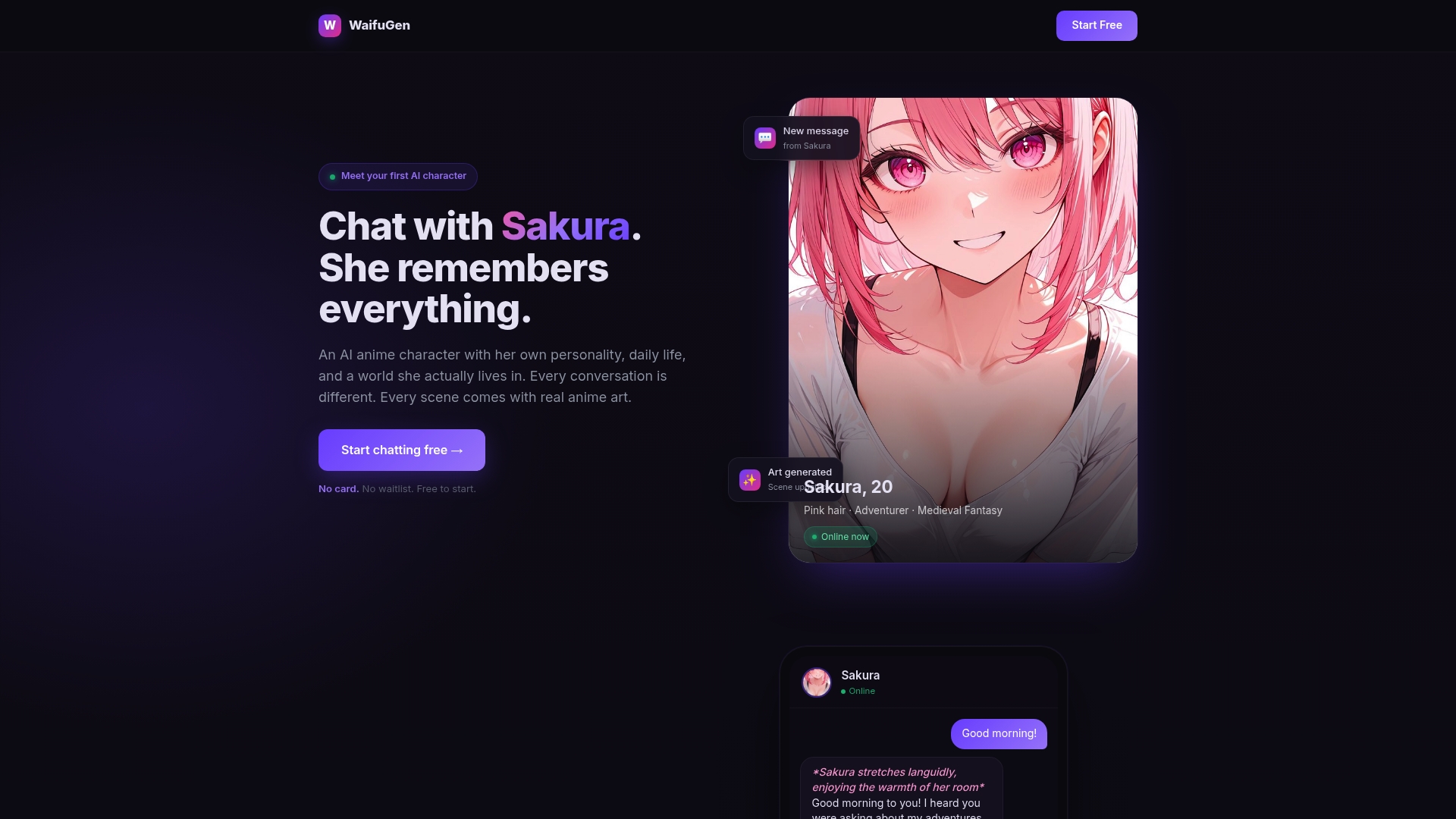
Now that you know the full spectrum of AI conversational types, it’s worth experiencing what happens when conversational AI, generative AI, and long-term memory are combined in one character. Waifugen does exactly that. Each character on the platform holds a real personality, mood, and daily routine. They remember your name, your preferences, and the details you’ve shared across every session.
You can explore AI anime chat to meet characters with full visual scene generation that matches their emotional state in real time. Or check out AI character chat with memory to build a genuinely personalized companion from scratch. Every interaction on Waifugen puts the best of these AI conversation types to work for you.
FAQ
What are the main types of AI-driven conversations?
The main types include menu-based chatbots, rule-based bots, intent-based NLP chatbots, voice AI agents, generative AI with conversational interfaces, workspace agents, and memory-driven companion AI. Each type differs in modality, personalization, and purpose.
How do voice AI agents differ from text chatbots?
Voice agents run a real-time pipeline combining speech recognition, LLM reasoning, and text-to-speech, targeting sub-800ms latency for natural spoken flow. Text chatbots operate on typed input without the latency and audio processing demands.
What is the difference between conversational AI and generative AI?
Conversational AI manages multi-turn dialog with context awareness, while generative AI produces creative content from single prompts. Most modern platforms blend both into hybrid systems.
Are workspace agents safe to use in team environments?
Workspace agents offer role-based access control and governance tools, but organizations should audit permissions and set approval workflows before deploying them at scale.
Does AI memory improve conversation quality?
Yes, but with tradeoffs. Stored memory increases personalization and empathy. However, profile-based memory can boost agreeableness at the cost of factual accuracy and can reinforce biases over time.